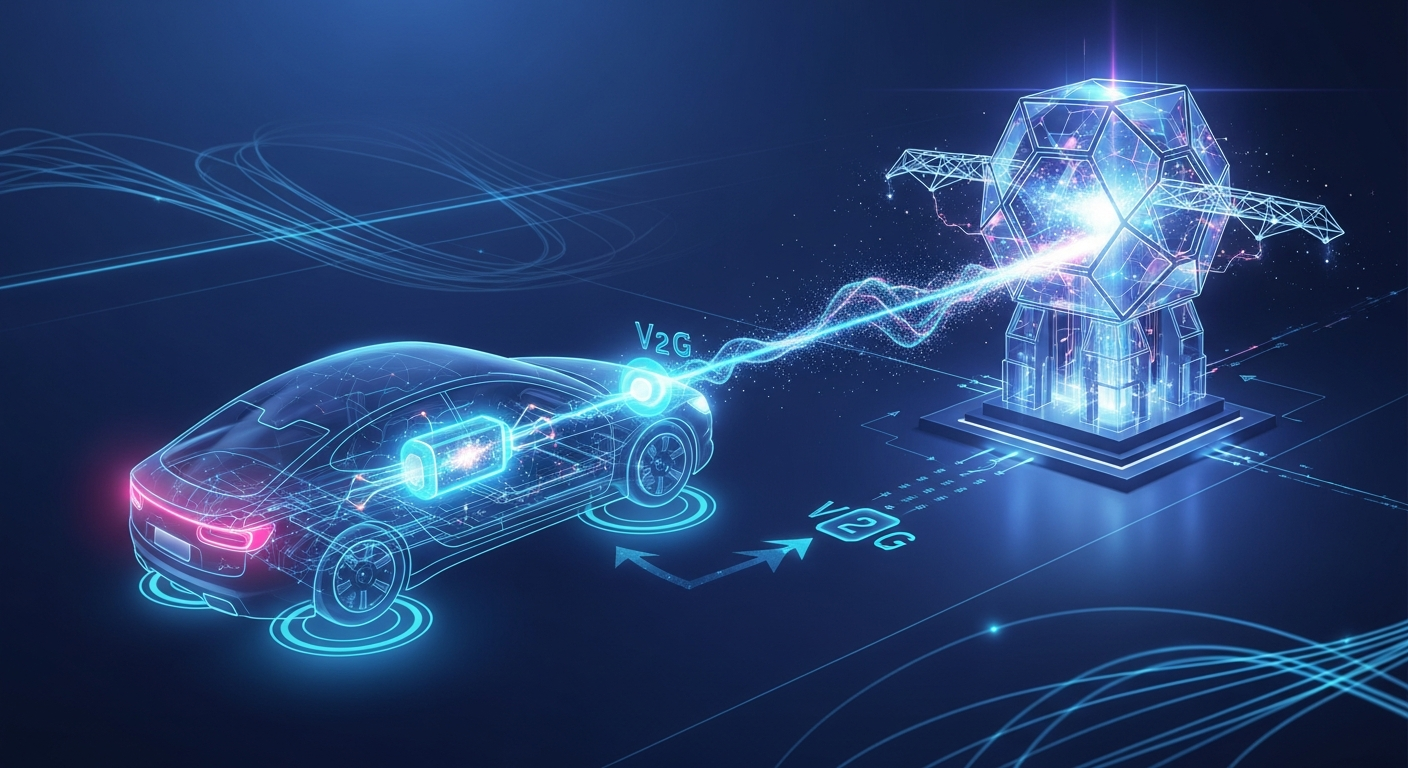
Vehicle-to-Grid Technology V2G Explained: The Future of the Energy Internet
The landscape of personal transportation is undergoing a metamorphosis that extends far beyond the shift from internal combustion to electricity. For decades, we have viewed the automobile as a depreciating asset that consumes energy to provide mobility. However, as we move through 2026, a radical technological shift is turning this paradigm on its head. Vehicle-to-Grid (V2G) technology is transforming the millions of electric vehicles (EVs) parked in driveways and parking lots into a massive, distributed energy storage system that can power our homes, stabilize our national grids, and even earn owners a passive income.
V2G is not just a feature; it is the backbone of the “Internet of Energy.” By allowing electricity to flow bi-directionally—both into the vehicle to charge the battery and back out to the grid when demand is high—EVs are becoming critical infrastructure for a sustainable future. This synergy between the transport and energy sectors is the missing piece of the renewable energy puzzle, providing the flexibility needed to manage the intermittent nature of wind and solar power. In this comprehensive guide, we will explore the technical architecture, the 2026 real-world landscape, and the profound impact V2G is having on our daily lives.
What is V2G? The Evolution of the EV Battery
At its core, Vehicle-to-Grid (V2G) technology describes a system in which plug-in electric vehicles communicate with the power grid to sell demand response services by either returning electricity to the grid or by throttling their charging rate. While standard EV charging is unidirectional (Grid-to-Vehicle or G2V), V2G requires bidirectional power electronics.
By 2026, the concept of “Smart Charging” or V1G has evolved into a fully realized V2X (Vehicle-to-Everything) ecosystem. This includes:
* **V2G (Vehicle-to-Grid):** Exporting power to the public utility grid to balance supply and demand.
* **V2H (Vehicle-to-Home):** Using the car’s battery to power a residential home during peak hours or outages.
* **V2B (Vehicle-to-Building):** Larger scale deployment where EV fleets power commercial office spaces to reduce peak demand charges.
* **V2L (Vehicle-to-Load):** Using the car to power specific devices, such as power tools or camping equipment, through a standard outlet.
The battery in a typical modern EV holds enough energy to power an average household for three to four days. When thousands of these batteries are networked together, they form what engineers call a “Virtual Power Plant” (VPP). In 2026, these VPPs are beginning to rival traditional gas-peaker plants in their ability to provide rapid-response energy to the grid.
The Mechanics of Bidirectional Power Flow
How does a car actually push power back into a high-voltage grid? The process is a masterpiece of modern power electronics and software orchestration.
1. The Hardware: Bidirectional Inverters
Standard EVs use an onboard charger to convert Alternating Current (AC) from the wall into Direct Current (DC) for the battery. In a V2G-enabled world, the vehicle or the charging station must be equipped with a bidirectional inverter. This device can reverse the process, converting the battery’s DC back into synchronized AC that matches the grid’s frequency (60Hz or 50Hz) and voltage.
2. The Communication Protocol: ISO 15118-20
By 2026, the international standard ISO 15118-20, also known as “Plug & Charge,” has become the universal language for V2G. This protocol allows the car, the charger, and the utility provider to exchange data securely. It handles everything from the car’s current State of Charge (SoC) to the owner’s minimum required range for the next morning.
3. The Aggregator
Individual EV owners do not interact directly with the energy markets. Instead, “aggregators”—often software companies or the automakers themselves—collect the energy capacity of thousands of connected vehicles. Using AI-driven algorithms, these aggregators predict energy price spikes and grid instability, signaling the fleet to discharge or charge in unison.
Real-World Applications in 2026: A New Energy Era
In 2026, V2G has moved out of the pilot phase and into mainstream adoption. The technology is being utilized in several high-impact scenarios that were merely theoretical a few years ago.
Grid Stabilization and Peak Shaving
During extreme weather events, such as heatwaves when air conditioning use skyrockets, the grid often struggles to keep up. In 2026, utilities use V2G to “shave” these peaks. Instead of firing up a coal or gas plant, the utility draws a few kilowatts from every connected EV. This prevents blackouts and reduces the carbon footprint of the entire energy system.
Integration with Renewables
Solar and wind energy are notoriously intermittent—the sun doesn’t always shine when we need to cook dinner. V2G acts as the ultimate buffer. During the day, EVs soak up excess solar energy that would otherwise go to waste. In the evening, when the sun sets and energy demand peaks, those same EVs feed that green energy back into the system.
Emergency Resilience and V2H
For homeowners, the most tangible benefit in 2026 is energy independence. In the event of a storm-induced power outage, a V2G-enabled EV becomes a giant uninterruptible power supply (UPS). Systems are now sophisticated enough to automatically disconnect the home from the grid (islanding) and run critical appliances for days, ensuring that “range anxiety” is replaced by “home energy security.”
The Economic Incentives: Turning Your Car into a Revenue Stream
One of the most compelling aspects of V2G in 2026 is the shift in the total cost of ownership (TCO) for electric vehicles. For the first time, a car can pay for itself while it is parked.
Energy Arbitrage
EV owners can engage in “energy arbitrage”—buying electricity when it is cheap (usually overnight) and selling it back to the grid when it is expensive (usually between 4:00 PM and 9:00 PM). In many regions, the price difference is significant enough to cover the owner’s monthly charging costs entirely.
Frequency Regulation Payments
The grid needs to maintain a precise frequency to function. Deviations can damage industrial equipment. EVs are incredibly fast at responding to frequency changes—much faster than traditional turbines. Utilities pay V2G aggregators “readiness” fees just to have the fleet available for these micro-adjustments. These payments are often passed back to the EV owner as credits on their utility bill or direct deposits.
Fleet Management for Businesses
In 2026, corporate fleets are the biggest proponents of V2G. Delivery companies with hundreds of electric vans use their idle time to support the local grid. This transforms a fleet from a massive overhead cost into a strategic energy asset that generates revenue during weekends and overnight periods.
Overcoming the Barriers: Battery Degradation and Infrastructure
Despite the progress in 2026, V2G technology has faced significant hurdles, primarily regarding battery health and hardware costs.
The Degradation Myth vs. Reality
The primary concern for EV owners has always been that V2G will “wear out” their battery. However, 2026-era battery chemistry, particularly Lithium Iron Phosphate (LFP), is designed for thousands of cycles. Furthermore, V2G discharging is typically done at a low power rate (5-10 kW), which is far less stressful on the battery than high-speed DC fast charging on a highway. AI-managed Battery Management Systems (BMS) ensure that the battery never discharges past a certain healthy threshold, preserving the vehicle’s longevity.
Hardware Standardization
The transition to V2G required a massive upgrade in charging infrastructure. Older “dumb” chargers are being replaced by smart, bidirectional units. While these units are more expensive, government subsidies and utility rebates in 2026 have made them accessible to the average homeowner.
Regulatory and Policy Shifts
Technological capability is nothing without policy. By 2026, many countries have updated their “Net Metering” laws to treat EVs as mobile storage units. Utilities have been mandated to simplify the interconnection process, making it as easy to plug in a V2G car as it is to plug in a smartphone.
The Daily Life Impact: A Day in the Life of a V2G User
To understand the impact of V2G, let’s look at a typical day for a tech-savvy EV owner in late 2026.
**07:00 AM:** You wake up to a fully charged car. Your home was powered by the car’s battery from 6:00 PM to 10:00 PM last night to avoid peak electricity rates, but the car automatically recharged using cheap wind energy between 2:00 AM and 5:00 AM.
**08:30 AM:** You drive to work. The car’s software knows your commute is 20 miles. It reserves 40% of the battery for “commute and errands” and marks the rest as “available for grid services.”
**10:00 AM:** At the office, you plug into a V2G-enabled charger. The sun is shining brightly, and there is a surplus of solar energy on the grid. Your car “buys” this excess energy at a near-zero rate.
**02:00 PM:** A cloud cover moves over a major solar farm nearby, causing a momentary dip in grid supply. Your car, along with 5,000 others in the parking structure, discharges a small amount of power for 10 minutes to stabilize the grid. You earn $2.00 for this automated transaction.
**06:00 PM:** You arrive home. The grid is under heavy load as everyone starts cooking and turning on lights. Your car plugs in and begins powering your house, saving you from high “Time-of-Use” rates.
**11:00 PM:** The “Energy Dashboard” on your phone shows that you earned $45 this month through grid participation, effectively making your “fuel” for the month free.
FAQ: Common Questions About V2G
1. Does V2G void my car’s battery warranty?
By 2026, most major manufacturers (including Tesla, Hyundai, Ford, and Volkswagen) have integrated V2G usage into their standard warranties. As long as you use manufacturer-approved software that manages discharge cycles responsibly, your warranty remains intact.
2. Can any EV do V2G?
No. It requires specific hardware (a bidirectional onboard charger) and software protocols. While many EVs in 2026 are V2G-ready, older models from the early 2020s may only support V1G (smart charging) or V2L (basic power out).
3. How much can I actually earn from V2G?
Earnings vary by region and energy market volatility. In 2026, active participants in high-demand areas are seeing returns between $400 and $1,200 per year. While it won’t make you rich, it significantly offsets the cost of the vehicle.
4. What happens if I need to leave suddenly and my battery is discharged?
V2G apps allow you to set a “Minimum Floor.” For example, you can tell the system to never let the battery drop below 50%. If you have an emergency, you will always have enough range to reach your destination.
5. Is the hardware for my home expensive?
Bidirectional home chargers are more expensive than standard Level 2 chargers. However, in 2026, many utilities offer these chargers for free or at a steep discount in exchange for the right to use the battery capacity during grid emergencies.
Conclusion: The Decentralized Energy Revolution
As we look toward the remainder of the decade, Vehicle-to-Grid technology stands as a testament to the power of convergence. It represents the point where the automotive, software, and energy industries collide to solve one of humanity’s greatest challenges: the transition to a carbon-neutral energy grid.
The significance of V2G extends far beyond the convenience of a backup power source or the perk of a smaller utility bill. It represents a fundamental shift in power—literally and figuratively. In the 20th century, energy was centralized, controlled by massive power plants and distributed one way to the masses. In 2026, energy is becoming democratic. Every EV owner is a micro-utility, a participant in a global network that is more resilient, more efficient, and infinitely cleaner.
The road ahead is clear. As battery costs continue to fall and AI-driven grid management becomes more sophisticated, the distinction between “transportation” and “utility” will continue to blur. Your next car won’t just be a way to get from A to B; it will be a cornerstone of the world’s most advanced energy machine. The V2G revolution has arrived, and it is charging our future in both directions.