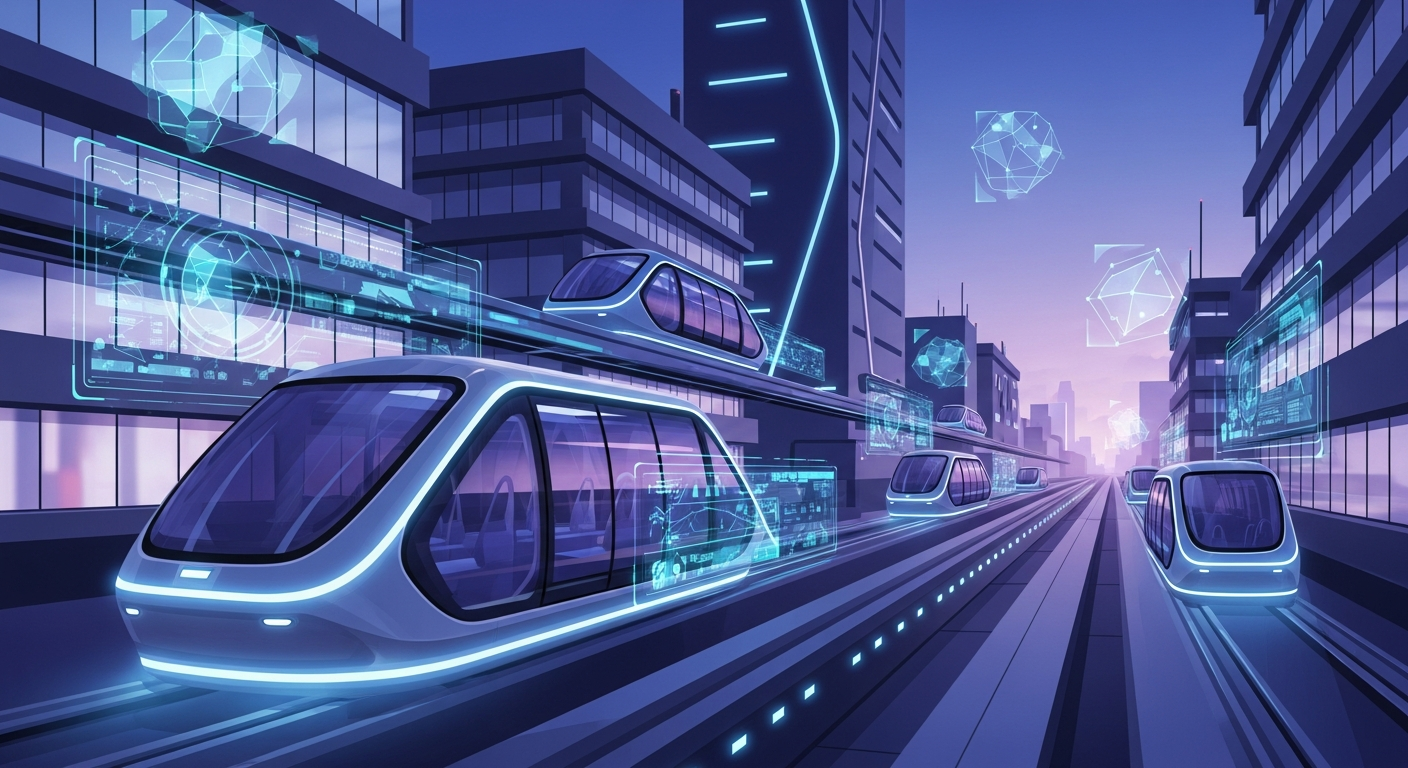
The Road to 2026: The Transformation of Autonomous Public Transport
The year 2026 marks a pivotal threshold in the history of human mobility. For decades, the dream of self-driving vehicles remained confined to the pages of science fiction or the controlled environments of high-tech testing grounds. However, as we navigate through 2026, the “driverless” revolution is no longer a localized experiment; it is the backbone of a new urban reality. The shift toward autonomous public transport represents more than just a technological upgrade—it is a fundamental restructuring of how cities breathe, move, and grow.
By 2026, the convergence of high-speed 5G connectivity, advanced Lidar systems, and sophisticated machine learning algorithms has moved beyond the “beta” phase. We are seeing a transition from individual car ownership toward highly efficient, AI-driven public transit networks. This evolution addresses the chronic issues of urban life: soul-crushing traffic congestion, high carbon emissions, and the “last-mile” connectivity gap. As we stand at this juncture, autonomous public transport is not just a luxury for the tech-elite; it is a vital utility, democratizing mobility and reclaiming the urban landscape for people rather than parking lots. This article explores the intricate technology, the real-world deployments, and the societal shifts that define the landscape of autonomous transit in 2026.
Defining Autonomous Public Transport: The Reality of Level 4 Automation
In 2026, the conversation around autonomous vehicles has matured. We no longer speak in vague terms about “self-driving cars.” Instead, the focus has shifted to Level 4 (L4) automation within public transit. According to the SAE International standards, Level 4 represents “High Automation,” where the vehicle can perform all driving tasks and monitor the environment in specific geographic areas or under certain conditions without human intervention.
In the context of 2026, this means that fleets of autonomous shuttles, buses, and light-rail systems operate entirely without a human driver behind a steering wheel—often because the steering wheel has been removed entirely. These vehicles are geofenced to specific urban centers, university campuses, and dedicated transit corridors. Unlike the experimental pods of the early 2020s, the 2026 generation of autonomous transit is rugged, weather-resistant, and capable of navigating complex “unstructured” environments, such as construction zones or unpredictable pedestrian behavior.
The core of this technology is “Software-Defined Mobility.” In 2026, the value of a public transport vehicle lies not in its chassis or engine, but in its operating system. These systems are constantly updated via over-the-air (OTA) patches, ensuring that every bus in a city’s fleet learns from the collective experiences of every other vehicle in the network. This collective intelligence ensures that if one autonomous shuttle encounters a new type of road hazard in one part of the city, the entire fleet is instantly programmed to recognize and safely navigate that hazard.
The Tech Stack: How 2026 Fleets Navigate the Urban Jungle
The sophistication of autonomous transport in 2026 relies on a multi-layered technology stack that provides “redundant perception.” To ensure 99.999% safety reliability, these vehicles do not rely on a single sensor type. Instead, they use “Sensor Fusion,” a process that blends data from three primary sources:
1. **Solid-State Lidar:** By 2026, Lidar (Light Detection and Ranging) has become significantly cheaper and more durable. These sensors pulse millions of laser beams per second to create a high-resolution 3D map of the vehicle’s surroundings, functioning perfectly in low-light or high-glare conditions where cameras might fail.
2. **Computer Vision and Neural Networks:** High-definition cameras coupled with onboard AI processors (capable of trillions of operations per second) identify and categorize objects. In 2026, these systems can distinguish between a child standing on a curb and a cardboard cutout, or predict if a cyclist is about to veer into the lane based on body posture.
3. **V2X (Vehicle-to-Everything) Communication:** This is the “secret sauce” of 2026. Vehicles no longer operate in isolation. Through V2I (Vehicle-to-Infrastructure) protocols, a bus “talks” to traffic lights, receiving a signal that the light will turn red in five seconds before it is even visible. Through V2V (Vehicle-to-Vehicle) communication, shuttles coordinate their speeds to maintain a “platoon,” reducing wind resistance and optimizing traffic flow.
Underpinning all of this is the 5G-Advanced (and early 6G) network. This low-latency connectivity allows for “Remote Tele-operation.” While the vehicle is autonomous, a human “fleet shepherd” in a centralized command center can monitor dozens of vehicles simultaneously. If a vehicle encounters a situation it cannot resolve—such as a police officer using hand signals to direct traffic—the remote operator can take control or provide the AI with a “path of intent” to follow.
Redefining the Commute: Real-World Applications in 2026
By 2026, the application of autonomous public transport has moved from niche pilots to integrated city services. One of the most significant shifts is the rise of **Autonomous Micro-transit**. These are on-demand, 6-to-12-passenger shuttles that operate via smartphone apps. Instead of following a rigid, centuries-old bus route, the AI dynamically calculates the most efficient path to pick up and drop off passengers in real-time. This has effectively solved the “last-mile” problem, connecting suburban residents to high-speed rail hubs without the need for a personal car.
Another major application is the **Autonomous Bus Rapid Transit (A-BRT)**. In major metropolises, high-capacity autonomous buses run in dedicated lanes with surgical precision. Because they can communicate with one another, these buses can “dock” at stations with millimeter accuracy, allowing for level boarding that is crucial for passengers with disabilities. They travel in platoons, essentially acting as a “trackless train” that can be decoupled during off-peak hours to save energy.
Furthermore, we are seeing the emergence of **Multi-Modal Hubs**. In 2026, a commuter might start their journey on an autonomous ferry, transition to an automated light-rail system, and finish the final mile in an autonomous “pod.” All of this is managed through a single “Mobility as a Service” (MaaS) subscription, where the AI optimizes the entire journey based on current traffic, weather, and the user’s personal schedule.
The Smart City Ecosystem: Integration with Urban Infrastructure
Autonomous transport in 2026 does not exist in a vacuum; it is part of a holistic “Smart City” ecosystem. The infrastructure of the city itself has been upgraded to support these vehicles. “Smart Pavement” embedded with sensors can monitor road temperature and grip, feeding that data directly to the autonomous fleet to adjust braking distances in rain or ice.
Traffic management has undergone a revolution. In 2026, “Green Waves” are no longer a lucky coincidence. The city’s central traffic AI coordinates with the autonomous fleet to ensure that public transport vehicles rarely have to stop at red lights. This synchronization reduces energy consumption and ensures that transit is often faster than driving a private vehicle.
Moreover, the physical layout of the city is changing. Because autonomous shuttles can be parked in dense, peripheral “hives” when not in use, the need for massive multi-story parking garages in city centers has plummeted. In 2026, we are seeing the first wave of “Urban Reclamation,” where former parking structures are being converted into affordable housing, vertical farms, or public parks. The autonomous system’s efficiency means fewer vehicles are needed to move the same number of people, freeing up valuable urban real estate.
Socio-Economic Impact: Sustainability, Accessibility, and the New Urban Fabric
The impact of autonomous public transport in 2026 extends far beyond mere convenience; it is a tool for social equity and environmental sustainability. From a climate perspective, the vast majority of autonomous fleets are fully electric. The AI’s ability to drive “optimally”—with smooth acceleration and regenerative braking—extends battery life and reduces energy waste by up to 20% compared to human-driven electric buses.
From a social perspective, accessibility has reached new heights. For the elderly, the visually impaired, or those with mobility challenges, the autonomous shuttle is a lifeline. These vehicles are designed with universal access in mind, featuring ramps that deploy automatically and AI voice interfaces that can communicate in dozens of languages. In 2026, your “driver” doesn’t just navigate the road; the onboard AI provides real-time information, assists with transfers, and ensures passenger safety through “smart cabin” monitoring.
Economically, the shift is profound. While there are ongoing discussions about the displacement of traditional driving jobs, new sectors are emerging in fleet management, remote tele-operation, and high-tech maintenance. For the average citizen, the cost of a MaaS subscription in 2026 is significantly lower than the total cost of owning, insuring, and parking a private car. This “mobility dividend” is putting more disposable income back into the hands of households, particularly in lower-income brackets.
Overcoming Hurdles: Regulation, Cybersecurity, and Public Trust
Despite the progress in 2026, the road has not been without its bumps. The transition to autonomous public transport has required a massive overhaul of legal and regulatory frameworks. One of the primary challenges has been the “Liability Shift.” When an autonomous bus is involved in an incident, who is responsible? The software developer? The sensor manufacturer? The city transit authority? By 2026, most jurisdictions have moved toward a “No-Fault” insurance model for autonomous transit, backed by government-mandated data black boxes that record every micro-second of a vehicle’s operation for forensic analysis.
Cybersecurity is another critical frontier. In a world where a city’s transport network is controlled by a central AI, the risk of a systemic hack is a national security concern. In 2026, autonomous systems utilize “Quantum-Resistant Encryption” and decentralized “Edge Processing” to ensure that even if one part of the network is compromised, the entire fleet doesn’t grind to a halt.
Finally, public trust remains a focus. While the safety statistics of 2026 prove that autonomous systems are significantly safer than human drivers, a single high-profile accident can still sway public opinion. Transit authorities have responded with “Radical Transparency,” providing passengers with real-time displays of what the bus “sees” and maintaining human “ambassadors” on larger routes to assist passengers and provide a sense of security, even if they aren’t steering the vehicle.
FAQ
1. Is autonomous public transport safe in 2026?
Statistically, yes. Data from 2026 indicates that autonomous fleets have reduced transit-related accidents by over 80% compared to human-driven vehicles. This is due to the elimination of human errors such as distraction, fatigue, and impaired driving.
2. Will autonomous buses replace human drivers entirely?
While the role of the traditional “driver” is changing, humans are still vital. Many transit workers have transitioned into “Fleet Operations Specialists,” “Remote Tele-operators,” or “In-Vehicle Concierges” who focus on passenger safety, assistance, and system oversight.
3. How do these vehicles handle extreme weather like heavy snow?
By 2026, sensor fusion (combining Lidar, Radar, and Thermal Imaging) has largely solved the “white-out” problem. Additionally, smart infrastructure provides localized data to the vehicles, allowing them to navigate safely even when lane markings are covered by snow.
4. Is my privacy protected when using these AI-driven systems?
Privacy is a major focus in 2026. Most transit systems use “Anonymized Data Processing,” where the AI recognizes a passenger for safety and ticketing purposes but does not store personally identifiable facial data unless specifically opted-in by the user for personalized services.
5. How much does it cost to use autonomous public transport?
In most cities, autonomous transit is cheaper than traditional bus or subway fares. The reduction in labor costs (for driving) and the increase in energy efficiency allow transit authorities to offer competitive pricing, often integrated into a monthly “Mobility as a Service” (MaaS) bundle.
Conclusion: Looking Toward a Post-Steering Wheel World
As we look beyond 2026, it is clear that we are witnessing the sunset of the era of the private, human-operated automobile as the primary mode of urban transport. The autonomous public transport systems of 2026 are the precursors to a fully integrated, “living” urban grid. In the coming decade, we can expect these systems to expand from geofenced urban centers to inter-city corridors, eventually creating a seamless web of mobility that spans entire continents.
The true success of autonomous transport in 2026 is not measured in the complexity of its code or the precision of its sensors, but in the silence of our streets and the clarity of our air. By removing the “driver” from the vehicle, we have put the “human” back at the center of urban design. The journey is no longer a stressful hurdle to be cleared; in 2026, the commute has become a space for productivity, relaxation, and connection. The road ahead is automated, but the destination is a more livable, equitable, and sustainable world for everyone.