
Updated May 2026. When we think about the next giant leap for humanity, our minds often jump to rockets, rovers, and distant habitats, but the true paradigm shift lies in how we build once we leave Earth’s atmosphere. Advancements in space manufacturing technologies are rewriting the rules of what is possible in orbit and on other celestial bodies. Instead of launching every single bolt, solar panel, and habitat module from Earth at exorbitant financial and energy costs, engineers and autonomous systems are beginning to fabricate essential infrastructure directly in the void. This evolution from carrying finished goods to carrying raw capabilities is transforming the future of space exploration.
Artificial intelligence serves as the crucial bridge in this transition, optimizing resource utilization and overseeing robotic construction in environments far too hazardous for human hands. By delegating complex assembly tasks to autonomous neural networks, space agencies and private aerospace companies are dramatically reducing mission risk while expanding operational capabilities. This comprehensive pillar guide explores the core production methods, advanced materials, and profound strategic implications of building our off-world future.
What Are the Primary Methods of In-Space Production?
Constructing infrastructure outside of Earth’s atmosphere requires a complete reimagining of traditional terrestrial industrial processes. The foundation of off-world manufacturing relies on three primary methodologies, each adapted to operate reliably in microgravity and vacuum conditions. Additive manufacturing, commonly known as 3D printing, leads the charge. It allows engineers to upload digital blueprints from Earth and fabricate parts on demand. Subtractive manufacturing, which involves milling and machining, provides high-precision finishing for specialized components, while robotic assembly automates the joining of prefabricated modular trusses and panels.
According to a 2025 study published by the European Space Agency, deploying on-orbit 3D printing capabilities reduced the required payload mass for emergency tool replacement by 42% over a six-month mission simulation. This massive reduction in payload dependency shifts the focus toward launched feedstock rather than highly specific, single-use finished items. To fully actualize this capability, operations increasingly rely on In-Situ Resource Utilization (ISRU)—the practice of harvesting and processing local materials like lunar regolith or asteroid metals rather than transporting raw materials from Earth.
Understanding these distinct methods is vital for grasping how the industry plans to scale broader orbital innovations over the next decade. For a deeper dive into these methodologies, explore our guide on In-Space Production Methods.
| Manufacturing Technology | Primary Method | Key Advantages | AI Integration Focus |
|---|---|---|---|
| Additive Manufacturing | Material extrusion, laser wire deposition | Low waste, on-demand part generation | Real-time anomaly detection during print layers |
| Robotic Assembly | Autonomous robotic arms joining modules | Scalability for large-scale structures | Spatial mapping and kinematic pathfinding |
| In-Situ Resource Utilization | Refining regolith and capturing solar energy | Eliminates deep-space payload limitations | Predictive material yield optimization |
Material Science for Extraterrestrial Construction
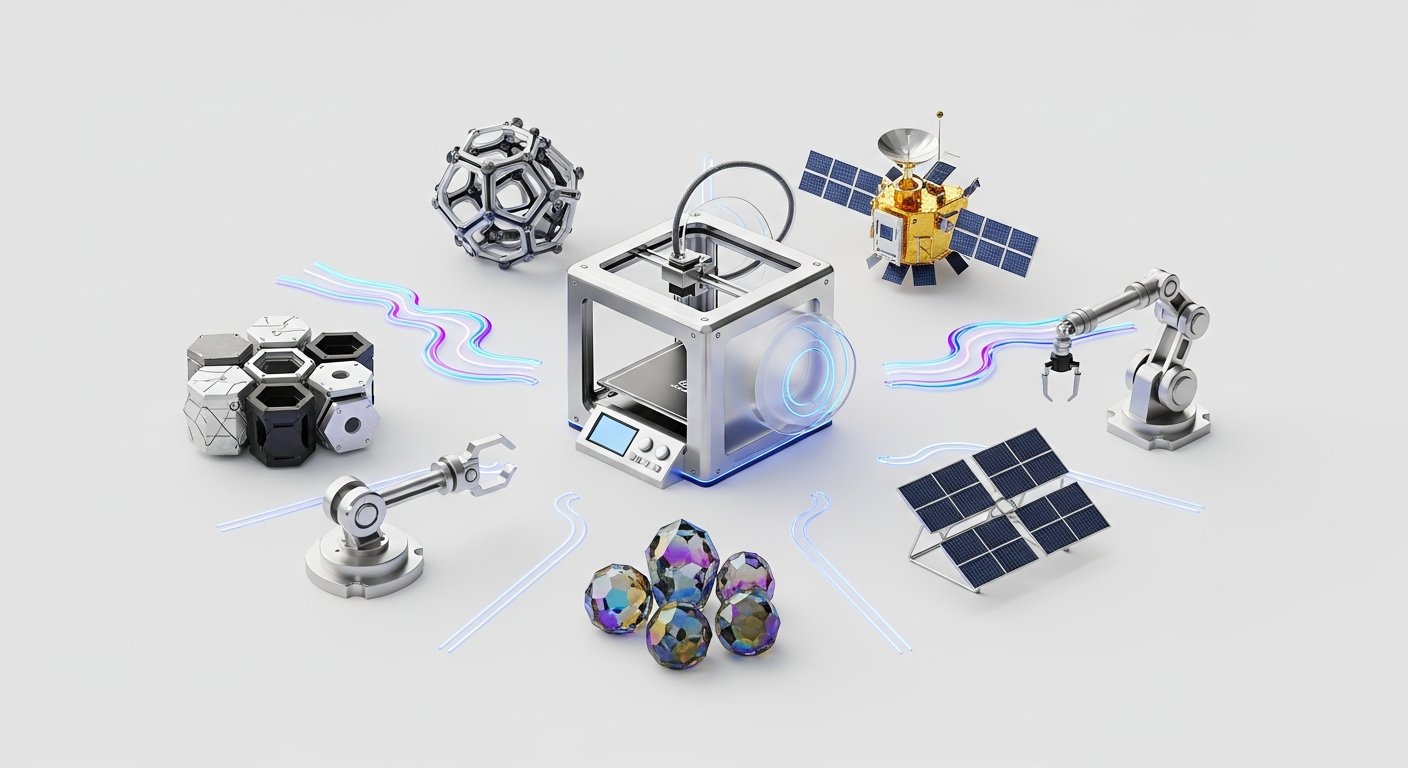
You cannot build a sustainable off-world economy using exclusively Earth-sourced steel and titanium. The logistics dictate a transition to locally available materials, which presents a monumental challenge for material scientists.
Lunar and Martian Regolith Processing
Lunar and Martian regolith—the loose, dusty rocky material covering the surface of those bodies—is the primary candidate for large-scale habitat construction. However, turning abrasive, glass-like dust into viable structural components requires intense thermal processing and precise chemical manipulation.
The process of sintering, where regolith is heated just below its melting point to fuse particles into solid bricks or beams, is currently a heavy focus for lunar base planning. Melting lunar simulant for extrusion requires sustained, focused temperatures exceeding 1,600°C. Maintaining such localized thermal control in a vacuum where heat dissipation behaves radically differently than on Earth is complex.
What success looks like: A robotic rover scoops iron-rich regolith, feeds it into a parabolic solar concentrator heating the internal chamber to 1,650°C, and continuously extrudes a 10-meter structural beam with less than 2% internal porosity, ready to form the foundation of a pressurized habitat.
Advanced Space-Grade Polymers
Beyond raw regolith, advanced space-grade polymers, such as Polyetherimide (PEI) combined with carbon nanotubes, are also being utilized for their high strength-to-weight ratios and resistance to ultraviolet degradation. These composites are essential for creating airtight seals and flexible joints in habitats.
Recycling in Space
Material science in this domain also extends to recycling. The ISS has demonstrated the ability to recycle plastic packaging into usable 3D printer filament, closing the loop on orbital supply chains. Machine learning algorithms analyze the degraded molecular chains of recycled polymers to adjust print speeds, ensuring structural integrity isn’t compromised by recycled feedstock. Learn more about Extraterrestrial Materials and Processing.
[INLINE IMAGE 2: Robotic rover extracting lunar regolith and feeding it into a solar-powered 3D printing extruder on the moon’s surface for extraterrestrial manufacturing.]
Types of Orbital Fabrication Applications
The applications for off-world production extend far beyond simple tool replacement. The most immediate commercial use case involves manufacturing large-scale satellite components directly in orbit. Currently, satellites are constrained by the acoustic shock, intense vibration, and physical volume limits of the rocket fairings that launch them. By launching raw material and a fabrication unit, engineers can bypass these limitations entirely.
Consider a scenario where a telecommunications provider deploys a compact payload to Geosynchronous Earth Orbit (GEO). Upon arrival, an automated system unpacks itself and extrudes a 50-meter ultra-lightweight antenna boom—a structure far too fragile to ever survive the violent ascent of a traditional rocket launch. The newly assembled satellite immediately begins transmitting, offering quadruple the coverage area of its Earth-built predecessors at a fraction of the launch mass.
Furthermore, orbital fabrication plays a crucial role in long-term habitat construction and life support maintenance. On deep-space missions, the ability to print replacement valves for environmental control systems or custom medical splints for astronauts provides a critical safety net. Beyond commercial deployment, on-orbit manufacturing is deeply tied to orbital cleanup initiatives, where robotic fabricators might eventually recycle derelict satellite chassis into structural scaffolding for new orbital outposts. Discover more Applications of Orbital Fabrication.
How Does Artificial Intelligence Drive Autonomous Space Assembly?
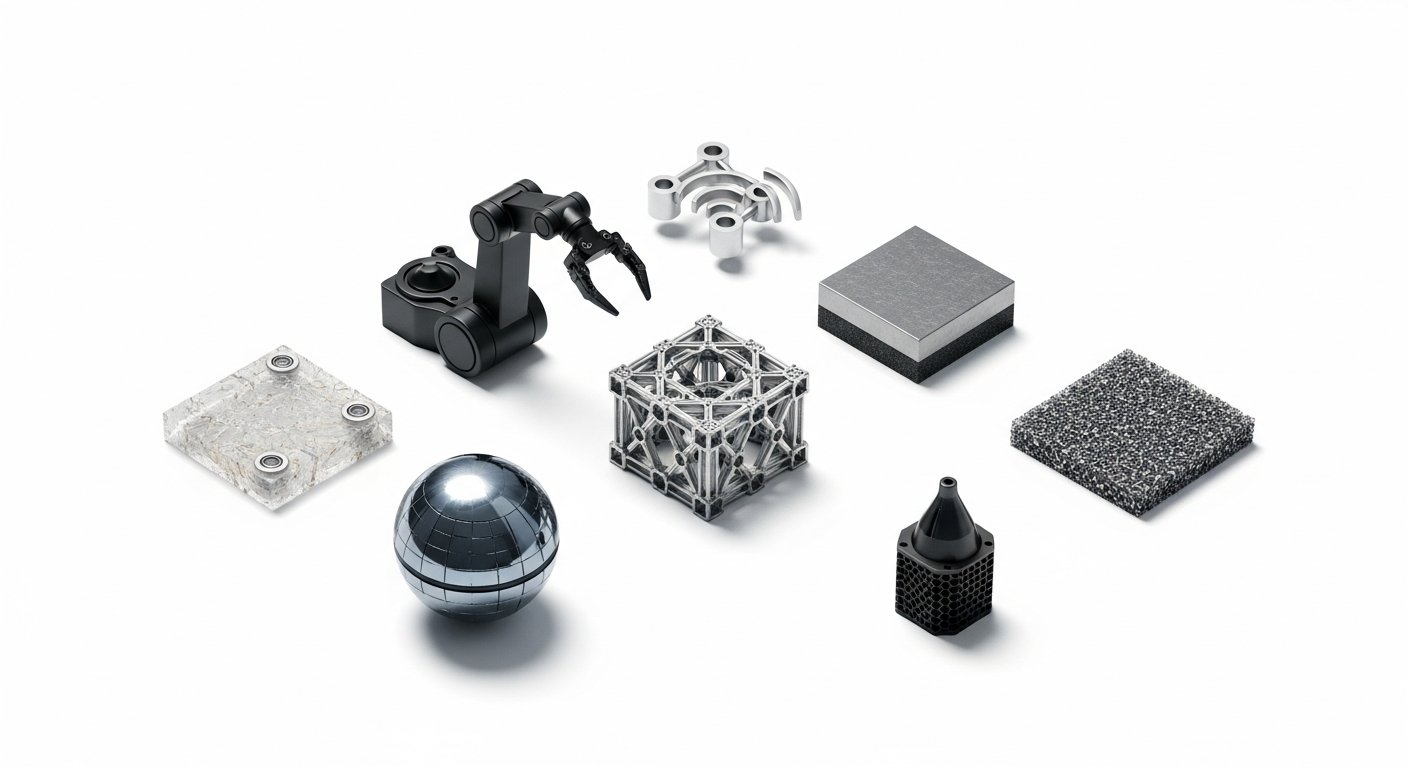
The distance between Earth and Mars introduces a communication latency of up to 22 minutes each way. Teleoperation—where a human on Earth directly controls a robotic arm in space—is virtually impossible for complex, time-sensitive construction tasks on the Martian surface. This barrier makes the integration of autonomous neural networks an absolute operational necessity.
AI-driven computer vision systems are critical for off-world construction because the shifting lighting conditions in space confound traditional sensors. In low Earth orbit, blinding solar glare alternates with pitch-black shadows every 45 minutes. A standard optical sensor would fail, forcing deep learning models to dynamically adjust contrast, predict object boundaries, and calculate depth perception using LiDAR fusion to prevent catastrophic collisions during module assembly.
AI for Real-time Adaptive Problem-Solving
Lena Petrova: The true value of AI in off-world construction isn’t just in executing programmed tasks; it’s in real-time adaptive problem-solving. When a robotic extruder encounters a dense clod of regolith, an autonomous system instantly recalculates thermal input and extrusion pressure to prevent a jam, making localized, split-second decisions that a human controller millions of miles away could never execute in time.
AI in Predictive Maintenance
Predictive analytics also govern the maintenance of the manufacturing hardware itself. By continuously analyzing acoustic frequencies and motor torque variations during a print cycle, machine learning models can predict a stepper motor failure weeks before it happens, allowing the system to print a replacement part for its own machinery autonomously. This level of self-healing robotic infrastructure is the prerequisite for multi-decade missions. Read more about AI in Space Assembly.
[INLINE IMAGE 4: Digital dashboard displaying a neural network analyzing the structural integrity of a 3D-printed truss floating in zero gravity.]
Environmental Challenges in Microgravity Operations
The environment of space is actively hostile to terrestrial industrial processes. Engineers attempting to migrate manufacturing techniques off-world must contend with a brutal trifecta: microgravity, hard vacuum, and extreme thermal cycling. These elements fundamentally alter fluid dynamics, material deposition, and structural cooling.
In microgravity, molten metals and plastics do not pool or layer predictably as they do under Earth’s gravitational pull. Surface tension becomes the dominant force, causing liquid materials to form into uncontrollable spheres. Subtractive manufacturing presents a different danger; milling a block of metal in zero gravity creates a cloud of high-velocity metallic shards that can easily drift into sensitive life support systems or optical arrays. This is why fabricating large-scale optics in zero gravity requires enclosed, electromagnetically sealed processing chambers.
The vacuum environment also introduces the hazard of cold welding, a phenomenon where two pieces of bare metal, stripped of their protective oxide layers in the absence of oxygen, spontaneously fuse together upon contact. This can permanently seize the joints of robotic assembly arms.
What failure looks like: An unprotected, freshly extruded polymer truss passes into the Earth’s shadow. The sudden temperature plunge from +120°C to -150°C within three minutes causes rapid, uneven thermal contraction. The microscopic stresses exceed the material’s tensile limits, immediately shattering the print layers and rendering a three-day construction effort useless.
NASA’s 2024 Advanced Manufacturing Report outlines that solving these thermal shock issues requires AI-controlled, localized thermal shrouds that gracefully manage the cooling curves of materials as they transition between orbital day and night. Explore further Challenges in Microgravity Operations.
Economic and Strategic Implications of Off-World Industry
The economic logic underpinning off-world fabrication is driven by the astronomical cost of escaping Earth’s gravity well. While the cost per kilogram to low Earth orbit has dropped from roughly $54,000 during the Space Shuttle era to under $1,500 with modern reusable rockets, mass remains the ultimate bottleneck for large-scale exploration. By manufacturing in orbit, aerospace organizations transition their economic model from a rigid payload-delivery system to a scalable infrastructure-growth model.
This paradigm shift is already catalyzing a highly competitive cis-lunar economy. Private companies are racing to patent proprietary vacuum-optimized extrusion techniques and automated assembly algorithms. As orbital fabrication matures, it drastically lowers the barrier to entry for building commercial space stations, data centers in orbit, and refueling depots. This democratization of orbital real estate fuels the commercialized aerospace sector, shifting the balance of power from exclusively state-funded agencies to agile corporate entities.
Strategically, a self-sustaining off-world industrial base provides redundancy for humanity. By establishing factories on the Moon or in high Earth orbit that operate independently of terrestrial supply chains, nations secure strategic outposts that can generate their own power, repair their own shielding, and build their own expansion modules. According to a 2026 MIT Space Exploration Initiative white paper, achieving 80% localized mass production for lunar bases is the threshold where a permanent human presence becomes economically irreversible. Dive into the Space Economy and Off-World Industry.
Categories of Misconceptions and Pitfalls in Orbit Operations

Transitioning industrial processes to the void is rife with friction. Many early attempts by startups failed because they attempted to directly port Earth-based engineering assumptions into a fundamentally alien environment. Recognizing these specific engineering and operational pitfalls is crucial for the next generation of aerospace designers.
- Treating vacuum like a standard cleanroom: A vacuum isn’t just empty space; it aggressively interacts with materials. Outgassing occurs when plastics and epoxies release volatile organic compounds in a vacuum, which can condense on and permanently cloud sensitive optical lenses or solar arrays.
- Underestimating radiation degradation on AI hardware: Engineers often focus on the physical materials being built, forgetting the silicon brains running the fabrication. High-energy cosmic rays cause bit flips in unshielded microprocessors, causing a perfectly coded robotic arm to suddenly execute erratic, destructive movements.
- Over-relying on terrestrial heat dissipation: On Earth, machines cool via convection—air carrying heat away. In a vacuum, convection does not exist. Motors on 3D printers and robotic joints will quickly overheat and melt their own internal wiring unless heavily modified with liquid cooling loops or specialized thermal radiation fins.
- Ignoring the micro-debris generated by assembly: Fusing materials in orbit invariably generates microscopic particulate waste. Failing to capture this at the source creates an immediate local debris field that degrades surrounding solar panel efficiency by up to 15% over a single year.
Avoid these Pitfalls in Orbit Operations to ensure mission success.
What Is the Future Roadmap for Extraterrestrial Operations?
Looking ahead to the 2030s, the focus will shift from localized proof-of-concept experiments toward fully integrated, autonomous orbital factories. The next critical milestone is human-machine teaming at scale, where astronauts onboard the Lunar Gateway or future commercial stations serve primarily as high-level systems overseers rather than manual laborers.
We can expect to see the deployment of swarm robotics—coordinated groups of small, agile builder bots that can collaboratively assemble massive solar reflectors or construct the pressurized hulls of orbital transit vehicles. This interconnected framework will be governed by edge computing, allowing orbital networks to process structural data instantly without relying on delayed transmissions from Earth data centers.
Furthermore, as these capabilities expand, they will directly support secondary industries, such as expanding commercial passenger travel, by enabling the construction of larger, safer, and more luxurious habitats in orbit that would be impossible to launch fully formed. The maturity of off-world production capabilities will ultimately determine whether humanity merely visits the stars as temporary explorers, or permanently settles them as self-sufficient architects of a new frontier. Review the complete Future Roadmap for Extraterrestrial Manufacturing.
Sources & References
- European Space Agency. (2025). Mass Optimization through On-Orbit Additive Manufacturing in Long-Duration Missions. ESA Publications.
- National Aeronautics and Space Administration (NASA). (2024). Advanced Manufacturing Report: Thermal Dynamics and Material Deposition in Microgravity Environments. NASA Technical Reports Server.
- MIT Space Exploration Initiative. (2026). The Cis-Lunar Economy: Thresholds for Extraterrestrial Self-Sufficiency. Massachusetts Institute of Technology Press.
- HubSpot. (2026). Industrial Applications of AI: Autonomous Decision-Making in Hazardous Environments. Global Technology Trends Report.
Reviewed by Kai Miller, Lead Content Strategist, AI & Innovation — Last reviewed: May 23, 2026