Knowledge Distillation: The Secret to Making Smaller Models Smarter
This is where Knowledge Distillation (KD) steps in as a transformative force. Rather than relying on raw computational power, KD focuses on architectural efficiency by transferring the “intelligence” of a gargantuan neural network into a lean, agile successor. This process allows us to maintain high levels of performance while drastically reducing the footprint of the AI. As we move into an era where on-device intelligence is a requirement rather than a luxury, understanding how we make smaller models smarter is no longer just a technical niche—it is the cornerstone of the next generation of ubiquitous computing.
The Master and the Apprentice: Understanding the Teacher-Student Dynamic
At its core, Knowledge Distillation is built upon a pedagogical framework known as the Teacher-Student architecture. In this scenario, the “Teacher” is a large, pre-trained model—often a deep neural network with hundreds of billions of parameters—that has already achieved high accuracy on a specific task. The “Student” is a much smaller model, designed with significantly fewer layers and parameters to ensure it can run on lower-power hardware.
The goal of distillation is not simply to have the Student mimic the Teacher’s final output. If the Student only learned the final “labels” (for example, identifying a photo as a “cat”), it would miss out on the nuanced understanding the Teacher possesses. Instead, the Student learns from the Teacher’s “soft targets.” These are the probability distributions the Teacher generates before it makes a final decision.
For instance, when a Teacher model looks at an image, it doesn’t just see a “cat.” It might see a 90% probability of a cat, a 9% probability of a dog, and a 1% probability of a car. That 9% “dog” probability contains vital information—it tells the Student that this specific cat has features (like fur or ear shape) that are dog-like. By capturing this “dark knowledge,” the Student develops a sophisticated internal representation of the data that far exceeds what it could learn from scratch using raw data alone.
The Mechanics of Modern Distillation: How Knowledge is Transferred

The technical process of distillation involves a specialized loss function that guides the Student during its training phase. Traditionally, a model is trained to minimize the difference between its prediction and the ground truth (the actual correct answer). In Knowledge Distillation, the Student has two objectives: it must minimize the “Student Loss” (matching the ground truth) and the “Distillation Loss” (matching the Teacher’s probability distribution).
A critical component in this process is a hyperparameter called “Temperature” (T). In a standard neural network, the final layer uses a Softmax function to produce probabilities. Usually, this function is “sharp,” meaning it pushes the highest probability toward 1 and others toward 0. During distillation, we raise the Temperature to “soften” these probabilities. This prevents the Student from only seeing the “correct” answer and instead forces it to see the entire spectrum of the Teacher’s reasoning.
Why “Small” is the New “Big” in the Modern AI Era
The shift toward smaller models is driven by three primary factors: Latency, Privacy, and Cost. In the high-stakes world of modern tech, these are non-negotiable pillars of user experience.
1. **Latency:** Sending data to a massive model in the cloud and waiting for a response takes time. For applications like real-time augmented reality or autonomous navigation, a delay of even a few hundred milliseconds is unacceptable. Distilled models reside locally on the device, providing near-instantaneous responses.
2. **Privacy:** Users are increasingly wary of sending sensitive personal data—be it voice recordings, health metrics, or private messages—to a centralized server. Knowledge Distillation allows powerful AI to live entirely “at the edge,” meaning your data never leaves your device. This localized processing is the ultimate safeguard for digital sovereignty.
3. **Sustainability and Cost:** The environmental impact of maintaining massive server farms is staggering. Smaller models require less electricity to train and significantly less energy to run. Furthermore, for companies, the cost of “inference” (running the model) is a major line item. Distilled models allow enterprises to serve millions of users with a fraction of the hardware investment.
By prioritizing efficiency, the tech industry is moving away from a centralized AI model toward a decentralized, democratic ecosystem where high-quality intelligence is accessible regardless of internet connectivity or hardware budget.
Real-World Applications: From Smart Glasses to Instant Translation
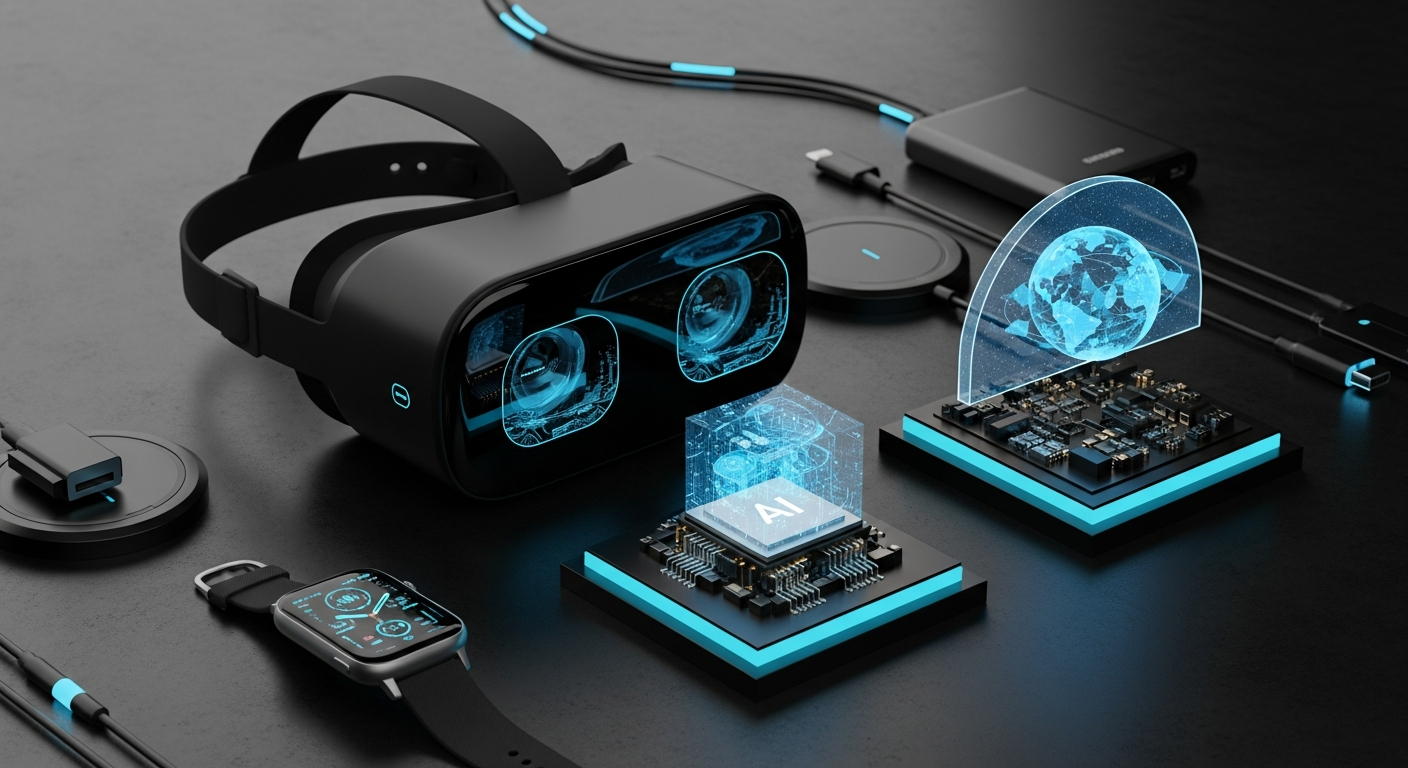
As we look at the practical implementation of these technologies in the coming years, Knowledge Distillation is the engine behind several “magic” experiences. We are moving away from clunky interfaces toward seamless, invisible AI.
In the realm of **Augmented Reality (AR) Wearables**, distillation is essential. Smart glasses need to perform complex object detection and spatial mapping in real-time. Because these devices have limited battery life and thermal constraints, they cannot run massive models. Distilled versions of computer vision networks allow these glasses to identify landmarks, translate street signs, and provide heads-up navigation without overheating on the user’s face.
**Personalized Healthcare** is another field feeling the impact. Imagine a continuous glucose monitor or a wearable EKG that uses a distilled transformer model to predict a medical event before it happens. Because the model is small, it can run continuously on a low-power chip, analyzing biometric data locally and only alerting a doctor when an anomaly is detected.
In **Automotive Technology**, distilled models are making autonomous features safer. While a central “brain” might handle long-term path planning, smaller distilled models can manage “reflex” actions—like emergency braking or lane-keeping—with zero-latency reliability. This hierarchy of models ensures that the most critical safety functions are never dependent on a cloud connection.
The Economic and Environmental Impact of Efficient AI
The move toward Knowledge Distillation isn’t just a win for performance; it is a necessity for global sustainability. The AI industry has often been criticized for its massive carbon footprint. Training a single large language model can emit as much carbon as several cars do over their entire lifetimes. Distillation offers a “recycle and reuse” path. We can train a massive Teacher once and then “distill” its wisdom into thousands of specialized, low-energy Student models.
Economically, this triggers a “Democratization of Intelligence.” In the past, only tech giants with multi-billion dollar data centers could deploy high-end AI. Today, a startup can take a powerful open-source Teacher model and distill it into a lightweight application that runs on a budget smartphone. This levels the playing field, allowing for innovation in emerging markets where high-speed internet and expensive hardware may be scarce.
Furthermore, we are seeing the rise of “Vertical Distillation.” Companies are taking general-purpose AI and distilling it into highly specialized models for law, finance, or engineering. These models don’t need to know how to write poetry or explain physics; they only need to be experts in their specific domain. This results in even smaller, more efficient models that outperform their massive Teachers in specialized tasks.
Overcoming the Challenges of Model Compression
While Knowledge Distillation is powerful, it is not a silver bullet. The process of shrinking a model involves inherent trade-offs, and researchers are still working to overcome several significant hurdles.
The most prominent challenge is the “Capacity Gap.” If the Teacher is too advanced and the Student is too simple, the Student may fail to learn anything meaningful. It’s like asking a primary school student to learn quantum physics directly from a Nobel laureate; the gap in foundational knowledge is too wide. To solve this, researchers often use “Intermediate Assistants”—medium-sized models that act as a bridge between the giant Teacher and the tiny Student.
Another difficulty lies in distilling “Reasoning.” While a Student model can easily learn to mimic patterns, it often struggles to replicate the step-by-step logical reasoning of a larger model. This is particularly evident in mathematical or coding tasks. Current research is focusing on “Feature-Based Distillation,” where the Student doesn’t just learn the output, but actually tries to mimic the internal “thought process” or activation patterns of the Teacher’s hidden layers.