The landscape of modern industry and daily life is being profoundly reshaped by the rapid evolution of technology. At the forefront of this transformation are advanced robotics applications, intelligent systems that are redefining efficiency, safety, and human potential across numerous sectors. These sophisticated machines, powered by AI and cutting-edge sensor technology, are not merely automating tasks but actively contributing to the Future Technology and the Evolving Workplace by creating new opportunities, demanding new skill sets, and prompting critical re-evaluations of human-robot collaboration.
From the precise movements of surgical robots to the autonomous navigation of warehouse logistics, advanced robotics are enabling unprecedented levels of performance. This article delves into the core components of these innovative systems, explores their diverse applications across manufacturing, healthcare, service industries, and hazardous environments, and critically examines their profound impact on the evolving workplace. We will also address the challenges, ethical considerations, and exciting future trends that accompany this technological revolution.
Defining Advanced Robotics: Beyond Traditional Automation
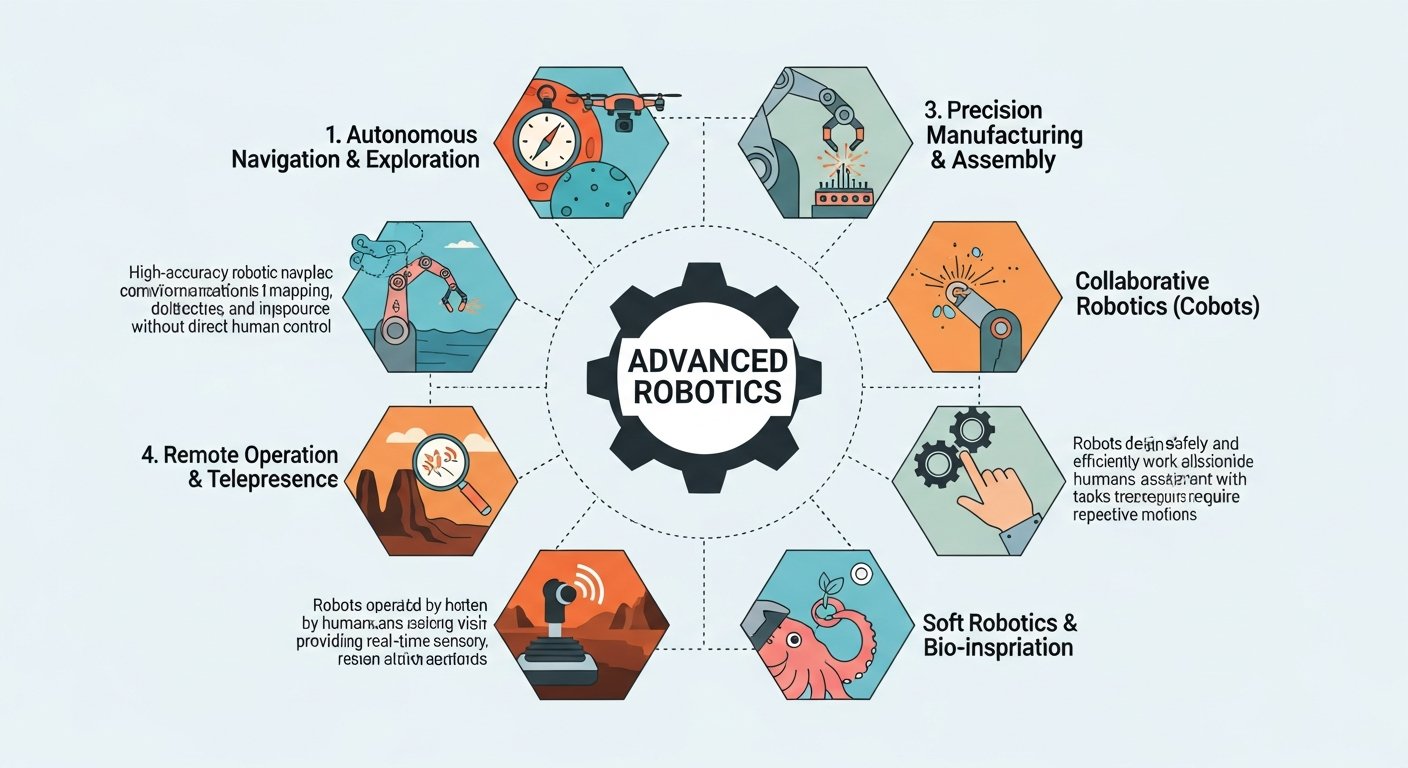
Advanced robotics signifies a leap beyond the repetitive, pre-programmed tasks of traditional industrial automation. These systems are characterized by their ability to perceive, process, and react to their environment with a degree of autonomy and intelligence previously unattainable. Attributes like high precision, adaptability, and real-time data processing are central to their functionality, allowing them to perform complex tasks in dynamic settings. The integration of artificial intelligence (AI) and machine learning (ML) empowers these robots to learn from experience, make informed decisions, and even interact intuitively with humans, distinguishing them from their simpler predecessors.
The Core Components of Intelligent Robotic Systems
At the heart of every advanced robotic system lies a sophisticated interplay of hardware and software. Sensor fusion, which combines data from various sensors (e.g., cameras, lidar, force sensors) provides a comprehensive understanding of the robot’s surroundings. This perception is then fed into AI-powered algorithms that enable tasks like object recognition, path planning, and autonomous navigation. Machine learning allows robots to refine their movements and decision-making over time, while real-time data processing ensures immediate responses to changing conditions. Scalability is also a key attribute, allowing these systems to be deployed across various operational scales, from individual workstations to vast industrial complexes, all while maintaining high safety standards.
What Differentiates Advanced Robotics from Simple Automation?
The distinction between advanced robotics and simple automation lies primarily in intelligence and adaptability. Simple automation systems typically execute a fixed sequence of actions. In contrast, advanced robotics applications leverage AI integration to adapt to unstructured environments, handle variability, and even engage in problem-solving. This includes features like predictive maintenance, where robots can anticipate failures and schedule servicing, and machine vision systems that perform detailed quality control. Furthermore, the capacity for human-robot collaboration, facilitated by advanced safety protocols and intuitive interfaces, marks a significant departure, fostering an evolving workplace where humans and robots work synergistically.
[INLINE IMAGE 1: diagram illustrating the core components and integration of advanced robotic systems, including AI, sensors, and actuators]
Robotics in Manufacturing & Logistics: Precision and Efficiency
Advanced robotics applications are fundamentally reshaping the manufacturing and logistics sectors, driving unprecedented levels of precision and efficiency. These intelligent systems are not only optimizing production lines and supply chains but also profoundly influencing the evolving workplace by creating new roles and demanding new skill sets from the human workforce. The push towards Industry 4.0 has seen factories transform into smart environments where robots communicate with each other and central systems, enabling dynamic adjustments and predictive maintenance strategies.
The Rise of Collaborative Robots (Cobots) in Production
Collaborative robots, or cobots, represent a pivotal shift in manufacturing. Designed to work alongside humans without safety cages, cobots facilitate human-robot teaming, enhancing productivity without requiring extensive reconfigurations of the workspace. Their attributes include adaptability to varying tasks, ease of programming, and integrated safety sensors that stop movement upon contact. This means human workers can focus on complex problem-solving, quality assurance, or customer interaction, while cobots handle repetitive or ergonomically challenging assembly tasks. Leading manufacturers like KUKA, FANUC, and Universal Robots are at the forefront of this evolution, offering flexible solutions for diverse production needs.
Optimizing Supply Chains with Autonomous Mobile Robots (AMRs)
In logistics, Autonomous Mobile Robots (AMRs) are revolutionizing warehousing and last-mile delivery. Unlike Automated Guided Vehicles (AGVs) that follow fixed paths, AMRs use AI, machine learning, and sensor fusion to navigate dynamic environments autonomously, avoiding obstacles and finding optimal routes. This enhances operational efficiency, reduces human error, and improves scalability for peak demand periods. The impact on the evolving workplace is significant, as human roles shift from manual material handling to overseeing fleets of robots, managing inventory systems, and ensuring seamless integration of automation technologies.
What are the Benefits of AI-Powered Quality Control?
AI-powered quality control robots leverage advanced machine vision and real-time data analysis to inspect products with exceptional precision and speed, often surpassing human capabilities. These systems can detect microscopic defects, measure dimensions accurately, and identify anomalies in materials, ensuring consistent product quality. The benefits include reduced waste, minimized recalls, and increased customer satisfaction. For the evolving workplace, this means human inspectors can transition to higher-level tasks, such as analyzing quality data, developing new inspection protocols, or managing the robotic systems themselves, thereby redefining human roles towards more analytical and strategic functions.
For an in-depth exploration of Robotics in Manufacturing, see our dedicated guide: Robotics in Manufacturing.
To understand more about logistics optimization, visit our cluster page: Logistics Automation.
How Are Advanced Robotics Transforming Healthcare and Medicine?
The healthcare and medical sectors are experiencing a profound transformation driven by advanced robotics applications. These sophisticated systems are enhancing diagnostic accuracy, improving surgical outcomes, and revolutionizing patient care and rehabilitation. The unparalleled precision and endurance of robotic systems address critical demands within healthcare, from minimizing invasiveness in surgery to providing continuous support for patients and medical staff, significantly impacting the evolving workplace by redefining human roles and increasing productivity gains.
Surgical Robotics: Enhancing Precision and Minimally Invasive Procedures
Surgical robots, such as the widely recognized Da Vinci Surgical System, empower surgeons with unparalleled precision, dexterity, and visualization. These systems facilitate minimally invasive procedures, leading to smaller incisions, reduced blood loss, faster recovery times, and decreased post-operative pain for patients. Attributes like tremor filtration, magnified 3D vision, and instrument articulation beyond human capability ensure safer and more effective interventions. The presence of surgical robots in operating rooms redefines the surgeon’s role, shifting focus from manual dexterity to strategic oversight, intricate control of robotic arms, and complex decision-making, while supporting staff adapt to new equipment and protocols.
Robotics in Patient Care, Diagnostics, and Rehabilitation
Beyond the operating room, intelligent automation systems are making significant strides in patient care, diagnostics, and rehabilitation. Robots like Moxi can assist nurses with routine tasks such as delivering supplies, freeing up human staff to focus on direct patient interaction and critical care. In diagnostics, AI-powered robots can analyze medical images with speed and accuracy, aiding early disease detection. Rehabilitation robotics provides personalized therapy, helping patients regain mobility through repetitive, precise exercises. Telemedicine is also benefiting from robotic integration, allowing remote consultations and even diagnostics. This expansion of robotic roles creates new job opportunities for robotics technicians, data scientists specializing in medical imaging, and professionals focused on human-robot interface design in clinical settings.
[INLINE IMAGE 2: infographic detailing various applications of robotics in healthcare, such as surgical assistance, patient transport, and diagnostic imaging]
For a detailed look at how these technologies are changing medical practice, explore our guide on: Robotics in Healthcare.
Service & Consumer Robotics: Enhancing Daily Life
The reach of cutting-edge robotic solutions extends well beyond industrial settings, increasingly permeating service industries and even our homes. These robots are designed to interact with people directly, offering convenience, assistance, and entertainment. Their integration into daily life underscores a broader shift in the evolving workplace, as routine service tasks become automated, allowing human workers to focus on more complex customer interactions, creative problem-solving, and managing these new robotic fleets.
Robotics in Hospitality and Retail
In hospitality, robots are serving guests in hotels, preparing food in restaurants, and even cleaning public spaces, enhancing operational efficiency and customer experience. For instance, robotic concierges can provide information, while autonomous floor cleaners maintain hygiene standards. In retail, intelligent automation systems are transforming inventory management, assisting customers with product location, and even handling checkouts. These applications improve speed, reduce wait times, and allow human staff to provide higher-value services, such as personalized recommendations or conflict resolution, thereby redefining human roles in customer service towards more empathetic and strategic interactions.
Personal Assistance and Domestic Robotics
The consumer market is witnessing a surge in personal assistance and domestic robots. From robotic vacuum cleaners and lawnmowers to sophisticated personal companions designed for elder care, these devices are simplifying household chores and offering companionship. Future robotics applications in this area promise even more advanced capabilities, including sophisticated humanoid robots that can perform a wider range of tasks and provide more nuanced support. While the impact on the formal “workplace” here is less direct, these robots fundamentally alter how individuals manage their personal time and daily responsibilities, indirectly influencing broader societal productivity and work-life balance.
Discover more about the impact of these innovations by reading our detailed guide on: Service Robotics.
What Role Do Advanced Robotics Play in Exploration and Hazardous Environments?
Advanced robotics applications are indispensable in environments that are too dangerous, remote, or extreme for human presence. These sophisticated robotic deployments extend our capabilities for exploration, data collection, and intervention in hazardous zones, from the vastness of space to the depths of the ocean and disaster-stricken areas. They exemplify resilience, autonomy, and remote operational control, allowing humanity to push boundaries while prioritizing safety.
Space Exploration and Deep-Sea Robotics
In space exploration, rovers and probes equipped with advanced sensor fusion, AI, and autonomous navigation capabilities are pivotal for studying distant planets, moons, and asteroids. Their ability to operate autonomously for extended periods in harsh, radiation-filled environments provides invaluable scientific data. Similarly, deep-sea robotics, including Remotely Operated Vehicles (ROVs) and Autonomous Underwater Vehicles (AUVs), are crucial for exploring uncharted ocean depths, conducting research, inspecting underwater infrastructure like pipelines, and even retrieving objects from the seabed. These robots leverage robust designs and real-time data transmission to overcome immense pressure and darkness, expanding our understanding of marine ecosystems and geological processes.
Disaster Response and Remote Inspection
When natural disasters strike or industrial accidents occur, advanced robotic solutions are deployed to assess damage, search for survivors, and mitigate hazards without risking human lives. Drones with thermal imaging, ground robots navigating debris, and specialized manipulators for hazardous material handling are common examples. Furthermore, remote inspection robots are utilized in industrial settings, such as nuclear power plants or chemical facilities, to monitor equipment, detect leaks, and perform routine checks in areas unsafe for human workers. These applications emphasize the safety attributes of advanced robotics, preventing human exposure to toxic substances, extreme temperatures, or unstable structures, and thereby reshaping emergency response protocols and industrial safety practices within the evolving workplace.
Explore the fascinating world of robotics in extreme conditions with our guide on: Exploration Robotics.
Challenges and Ethical Considerations in Robotics Adoption
While the benefits of intelligent automation systems are compelling, their widespread adoption also introduces significant challenges and ethical considerations that demand careful attention. Addressing these issues is crucial for ensuring that the integration of advanced robotics into society and the workplace is both beneficial and equitable. From data privacy to the very nature of human work, the societal impact is profound.
Data Privacy, Bias, and Accountability
Advanced robotics, particularly those integrated with AI and machine learning, often rely on vast amounts of data for their operation and learning. This raises critical concerns regarding data privacy, especially when robots collect information in public or sensitive environments like healthcare. Furthermore, if the training data used for AI algorithms is biased, the robots themselves can perpetuate or even amplify these biases, leading to discriminatory outcomes. Establishing clear lines of accountability when a robot makes an error or causes harm is another complex ethical dilemma, requiring legal and regulatory frameworks to adapt to these new forms of agency.
Security Vulnerabilities and Societal Impact
As robotics become more interconnected and autonomous, they also become potential targets for cyberattacks. A compromised robotic system in critical infrastructure or a factory could lead to significant disruptions, economic losses, or even physical harm. Beyond security, the broader societal impact of robotics adoption—particularly concerning job displacement versus job creation, income inequality, and the psychological effects of human-robot interaction—requires careful consideration. Ethical frameworks must guide the development and deployment of sophisticated robotic deployments to ensure they align with human values and contribute positively to the evolving workplace, focusing on reskilling initiatives and policies that support workers through transitions.
To delve deeper into these critical issues, refer to our comprehensive article on: Ethics in AI and Robotics.
Common Mistakes in Robotics Adoption
Implementing next-generation automation technologies effectively requires strategic planning and foresight. Many organizations, eager to capitalize on the benefits, often overlook crucial steps, leading to suboptimal outcomes or outright failures. Avoiding these common pitfalls is essential for a successful transition into a robotic-enhanced future.
- Overlooking Workforce Training and Reskilling: One of the most frequent mistakes is neglecting to adequately train existing employees for new roles or reskill them for collaboration with robots. This can lead to resistance, skill gaps, and underutilization of robotic assets.
- Underestimating Integration Complexity: Organizations often underestimate the technical challenges of integrating new robotic systems with existing infrastructure, software, and workflows. This can cause delays, budget overruns, and compatibility issues.
- Ignoring Ethical Frameworks and Governance: Failing to establish clear ethical guidelines for data usage, bias mitigation, and accountability can lead to public mistrust, regulatory hurdles, and unforeseen societal consequences.
- Focusing Only on Cost Savings, Not Value Creation: While cost reduction is a benefit, a narrow focus can miss the broader opportunities for innovation, improved quality, new service offerings, and enhanced human capabilities that robotics can provide.
- Lack of Scalability Planning: Deploying a single robot without a clear strategy for scaling the solution across the organization or adapting it to future needs can limit its long-term impact and return on investment.
- Poor Human-Robot Interface Design: If the interface for interacting with robots is not intuitive or user-friendly, it can hinder efficient collaboration and lead to frustration among human operators.
| Application Area | Key Robotic Technologies | Primary Benefits | Workplace Impact (Job Evolution) | Example Robot/System |
|---|---|---|---|---|
| Manufacturing | Cobots, AMRs, AI Vision | Precision, Efficiency, Scalability | Shift to oversight, programming, maintenance; new roles in HRC | Universal Robots UR10, KUKA LBR iiwa |
| Healthcare | Surgical robots, Patient care robots | Minimally invasive, Diagnostic accuracy, Staff support | Surgeons as operators, nurses managing robotic assistants, new rehabilitation specialists | Da Vinci Surgical System, Moxi robot |
| Logistics | AMRs, Robotic pickers, Drones | Supply chain optimization, Inventory accuracy, Faster delivery | Human roles in fleet management, data analysis, strategic planning | Boston Dynamics Stretch, Amazon Robotics Kiva |
| Service | Customer service robots, Cleaning robots | Enhanced customer experience, Operational efficiency, Hygiene | Focus on complex customer service, creative problem-solving, robot maintenance | Pepper robot, Roomba |
| Exploration & Hazardous Environments | Rovers, AUVs, Disaster response robots | Human safety, Data collection in extreme conditions, Remote intervention | Specialized operators, data scientists, mission planners | NASA Mars Rovers, Bluefin-21 AUV |
The Future of Advanced Robotics and the Evolving Workplace
The trajectory of advanced robotics is one of continuous innovation, promising even more sophisticated capabilities and profound impacts on the Future Technology and the Evolving Workplace. As these cutting-edge robotic solutions become more integrated and intelligent, they will not only reshape industries but also redefine human roles, requiring a proactive approach to skill development and collaboration models.
Reskilling and Upskilling for the Robotic Age
The proliferation of sophisticated robotic deployments necessitates a focused effort on reskilling and upskilling the global workforce. As robots take over repetitive or hazardous tasks, human workers will need to acquire new competencies in areas like robot programming, AI oversight, data analytics, and human-robot interaction (HRI) design. Educational institutions, industry leaders, and government initiatives are increasingly collaborating to bridge these skill gaps, preparing individuals for an evolving workplace where continuous learning is paramount. This proactive approach ensures that job displacement is mitigated by job creation, with humans transitioning to roles that leverage uniquely human attributes like creativity, critical thinking, and empathy.
How Will Human-Robot Collaboration Evolve?
The future of human-robot collaboration envisions a more seamless and intuitive partnership. Advances in AI, natural language processing, and haptics will allow robots to understand human intentions better, anticipate needs, and adapt their behavior in real-time. This could manifest as robots becoming more like intelligent assistants, working side-by-side with humans in a truly symbiotic relationship. The emphasis will shift from mere co-existence to genuine collaboration, where humans provide strategic direction and oversight, and robots execute with precision and efficiency, fundamentally shaping the future of work through increased productivity and new skill demands centered on communication and teamwork with artificial entities.
Emerging Trends: Next-Gen AI and Swarm Robotics
Looking ahead, several emerging trends promise to further revolutionize advanced robotics. Next-generation AI, particularly in areas like reinforcement learning and explainable AI (XAI), will make robots even more autonomous and capable of complex decision-making, offering greater transparency in their reasoning. Swarm robotics, where multiple small, simple robots work together to achieve a complex goal, will unlock new possibilities in logistics, environmental monitoring, and construction. Soft robotics, using flexible and compliant materials, will enable robots to interact more safely and delicately with humans and fragile objects. These future robotics applications will demand new ethical considerations and technical standards, pushing the boundaries of what’s possible and continually redefining our interaction with technology.
For an in-depth understanding of how our work lives will change, see our dedicated guide: Future of Work with AI.
In conclusion, the journey of advanced robotics applications is far from over. From enhancing manufacturing precision and transforming healthcare to enabling exploration in hazardous environments, these intelligent systems are not just tools but active shapers of our technological future and the evolving workplace. As we navigate the complexities of integration, ethical considerations, and workforce reskilling, the potential for these innovations to drive unprecedented productivity gains, create new job roles, and ultimately elevate human potential remains immense. The collaborative future of humans and robots is not just an aspiration but an imperative, promising a more efficient, safer, and ultimately more innovative world.
Sources & References
- World Economic Forum. (2023). *The Future of Jobs Report 2023*. Retrieved from weforum.org
- European Commission. (2021). *Ethics Guidelines for Trustworthy AI*. Retrieved from ec.europa.eu
- Brooks, R. (2019). *Robot Dreams*. Pantheon.
- Arntz, M., Gregory, T., & Zierahn, U. (2017). *Revisiting the Risk of Automation and Robotization to Employment*. OECD Social, Employment and Migration Working Papers, No. 202, OECD Publishing, Paris.
- Siciliano, B., & Khatib, O. (Eds.). (2026). *Springer Handbook of Robotics* (3rd ed.). Springer.
About the Author
Lena Petrova, Principal AI Ethicist & Futures Strategist — I’m a passionate advocate for responsible innovation, guiding organizations to leverage AI ethically for sustainable growth and a human-centric future of work.
Reviewed by Kai Miller, Lead Content Strategist, AI & Innovation — Last reviewed: March 27, 2026