Beyond the Screen: How Smart Textiles are Redefining Comfort and Performance in 2026
For decades, the “wearable tech” revolution was confined to our wrists and eyes. We strapped on smartwatches and slipped on augmented reality glasses, treating technology as an accessory rather than an extension of our physical selves. However, by 2026, the paradigm has shifted. We no longer just “wear” technology; we inhabit it. Smart textiles—fabrics infused with digital components, sensors, and conductive materials—have moved from the laboratory to the mainstream, fundamentally altering how we perceive comfort and human performance. This evolution represents the ultimate convergence of materials science, data analytics, and fashion. It is a world where your shirt monitors your cardiac health, your leggings correct your yoga form in real-time, and your jacket adjusts its thermal properties based on your metabolic rate. As we navigate the complexities of modern life, these intelligent fabrics serve as a silent, invisible layer of support, optimizing our biology and protecting us from environmental stressors without the need for a glowing screen. The era of the “Internet of Outfits” has arrived, making the clothing we wear as vital to our digital ecosystem as the smartphones in our pockets.
The Architecture of Intelligence: How Smart Fabrics Work
To understand the impact of smart textiles, one must first look at the microscopic level where chemistry meets computation. At its core, a smart textile is a fabric that can sense and react to environmental stimuli, such as temperature, pressure, or chemical changes. In 2026, this is achieved through three primary methods: embedded sensors, conductive yarns, and functional finishes.
The most advanced e-textiles utilize “conductive yarns”—fibers coated with silver, graphene, or carbon nanotubes. Unlike the bulky wires of early prototypes, these fibers are indistinguishable from cotton or polyester to the human touch. They are woven directly into the garment’s structure, creating a flexible circuit board that moves with the body. This allows for the integration of Triboelectric Nanogenerators (TENGs), which can harvest energy from the wearer’s movement to power small sensors, reducing the reliance on traditional batteries.
The “brain” of the garment is typically a miniaturized, flexible microcontroller, often tucked into a seamless pocket or laminated directly onto the fabric. These controllers use Edge Computing to process biometric data locally, ensuring privacy and reducing latency. Whether it is a piezoelectric sensor measuring the expansion of the chest for breathing rates or thermistors tracking skin temperature, the architecture of 2026 smart textiles is built on the principle of “invisible integration”—tech that works perfectly because you forget it’s even there.
Thermal Autonomy: Achieving the Perfect Microclimate
One of the most profound impacts of smart textiles in 2026 is the democratization of personal thermal comfort. For over a century, heating and cooling were functions of the building or the vehicle. Today, smart textiles provide “thermal autonomy,” allowing individuals to maintain their preferred microclimate regardless of their surroundings.
This is achieved through the use of Phase Change Materials (PCMs) and active heating elements. PCMs are substances that absorb or release heat as they change from solid to liquid and back again. In 2026, these materials are micro-encapsulated into the fibers of everyday office wear. When you step from a chilly autumn street into a crowded, overheated subway car, the fabric absorbs your excess body heat, storing it within its molecular structure. When you step back out into the cold, the material crystallizes, releasing that stored heat back to your body.
Furthermore, active smart garments now feature “dynamic porosity.” Using shape-memory polymers, the weave of a shirt can literally open up to increase breathability when it senses sweat or an increase in skin temperature. Conversely, the fibers can contract to seal in warmth when the ambient temperature drops. This level of responsiveness ensures that “comfort” is no longer a static state, but a dynamic, automated process managed by the very threads we wear.
Performance Optimization: The New Standard for Fitness and Work
In 2026, the distinction between a casual athlete and a professional is bridged by data-driven textiles. Performance optimization is no longer about just tracking steps; it is about analyzing the biomechanics of movement. Smart compression gear now features integrated Electromyography (EMG) sensors. These sensors measure the electrical activity of muscles, providing the wearer with a heat map of muscle activation via a haptic buzz or a smartphone interface.
If you are lifting weights and your left quadriceps are doing 20% more work than your right, your leggings will vibrate to notify you, preventing injury and ensuring balanced muscle development. This tech has also migrated into the workplace. For industrial workers and those in high-stress roles, smart exoskeletal fabrics provide lumbar support and posture correction. If a warehouse worker attempts to lift a heavy box with poor form, the fabric across the lower back stiffens, providing physical resistance that forces the user into a safer ergonomic position.
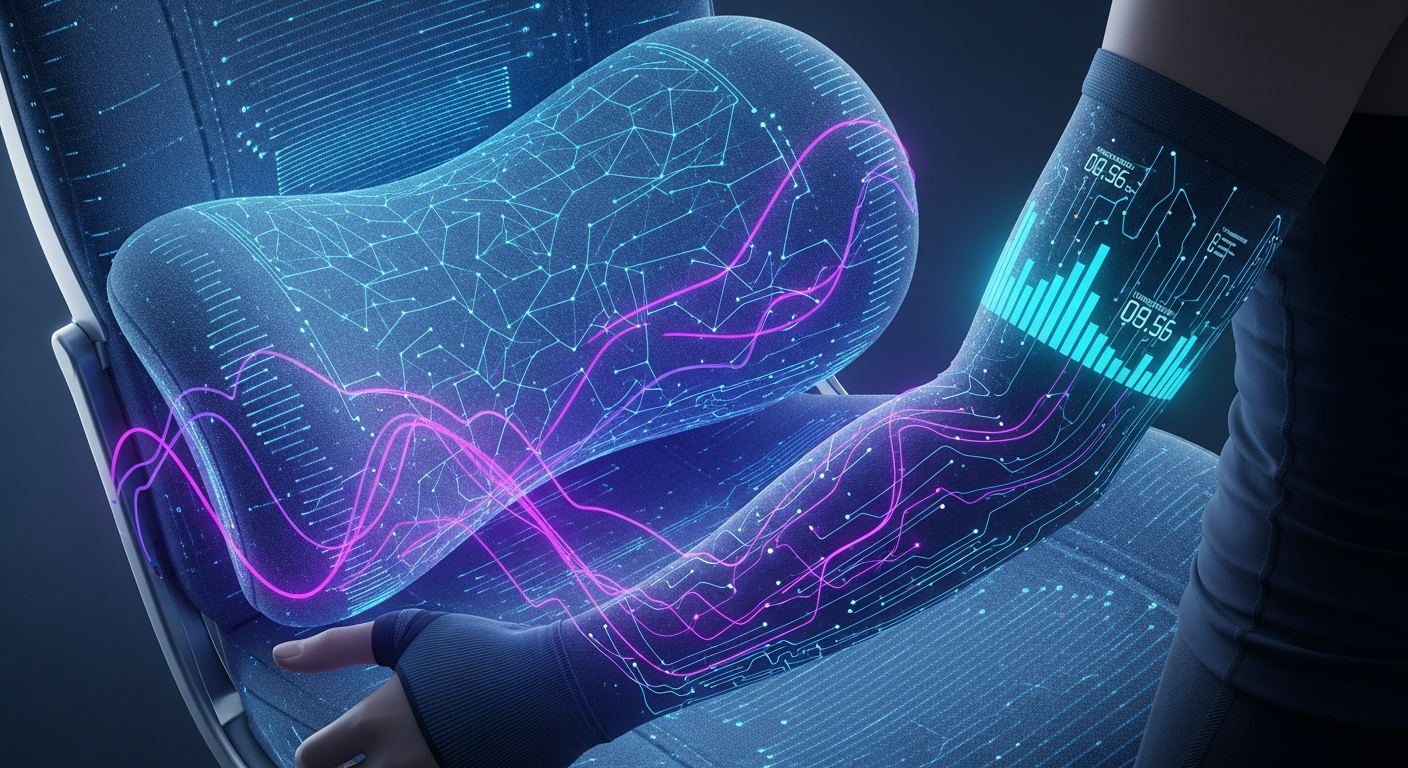
In the corporate world, smart textiles are being used to combat the “sedentary fatigue” of desk work. Smart chairs and shirts work in tandem to monitor slouching and heart rate variability (HRV). By 2026, these systems can detect the onset of mental fatigue or stress before the user is even consciously aware of it, suggesting a break or adjusting the ambient lighting in the room to boost productivity.
The Clinic on Your Back: Healthcare and Wellness Integration
Perhaps the most significant leap forward is the role of smart textiles in preventative healthcare. We have moved away from the “reactive” model of medicine toward a “continuous monitoring” model. In 2026, smart textiles serve as a secondary skin that acts as a 24/7 medical grade diagnostic tool.
For patients with chronic conditions like arrhythmia or hypertension, “smart pajamas” and everyday undergarments provide continuous ECG and blood pressure monitoring. This data is encrypted and sent to healthcare providers, allowing for the detection of anomalies weeks before they might lead to a clinical emergency. For the elderly, “fall-detection” fabrics have become a life-saving standard. These garments use highly sensitive accelerometers and pressure sensors to distinguish between a user sitting down quickly and a dangerous fall. In the event of a fall, the garment can automatically alert emergency services and provide the user’s exact GPS coordinates and vital signs.
Beyond clinical use, wellness-focused textiles are improving daily life through “chromotherapy” and “aromatherapy” integration. Some high-end sleepwear in 2026 is infused with micro-capsules that release calming scents like lavender based on the user’s cortisol levels, or use light-emitting fibers to provide low-level red light therapy, which has been shown to improve muscle recovery and skin health during sleep.
Sustainability and the Circular Economy of E-Textiles
A major challenge for smart textiles was the environmental impact of mixing electronic components with degradable fabrics. However, by 2026, the industry has embraced a circular economy model. The tech-savvy consumer of today demands that their “intelligent” wardrobe doesn’t contribute to the global e-waste crisis.
The breakthrough came with the development of “biodegradable electronics” and “modular hardware.” Many smart garments now feature a “clip-in” sensor module that can be removed before the garment is washed or recycled. The conductive traces themselves are often printed using organic, water-based inks that can be separated from the polyester or cotton during the recycling process.
Moreover, smart textiles are actually extending the lifespan of our clothing. Because these garments can monitor their own “health”—tracking the degradation of fibers or the loss of elasticity—they can alert the user when a repair is needed, rather than waiting for the garment to fail. In 2026, many brands offer “Software as a Garment” (SaaG) models, where the hardware remains the same, but the user can subscribe to new features—such as updated fitness tracking algorithms or new haptic feedback patterns—ensuring the clothing stays technologically relevant for years, reducing the “fast fashion” cycle.
FAQ: Understanding the Smart Textile Landscape
1. Are smart textiles safe to wash in a standard washing machine?
In 2026, most consumer-grade smart textiles are rated for at least 50 to 100 industrial wash cycles. The conductive yarns are encapsulated in protective polymers, and the primary sensor modules are usually detachable. However, it is always recommended to use a gentle cycle and air-dry to maintain the integrity of the delicate sensors.
2. How do these garments stay powered? Do I have to plug in my shirt every night?
While some high-performance gear requires a small rechargeable battery, many 2026 textiles utilize energy harvesting. Kinetic energy from your movement and thermal energy from your body heat provide enough power for low-energy Bluetooth (BLE) sensors. For active heating garments, a small, flexible battery pack (similar in size to a credit card) is typically required.
3. Is my biometric data secure?
Security is a top priority in 2026. Most smart garments use “on-device” processing, meaning your heart rate or sweat analysis is processed on the garment’s micro-chip and only the high-level results are sent to your phone. Data transmission is usually protected by end-to-end encryption, similar to the protocols used by modern banking apps.
4. Are smart textiles significantly more expensive than regular clothing?
While there is still a premium for “ultra-smart” garments, the cost has dropped significantly since the early 2020s. Basic smart textiles—such as those with simple moisture-wicking or basic thermal regulation—are now priced similarly to high-end athletic wear. The “intelligent” versions with full biometric suites remain in the luxury or specialized equipment price bracket.
5. Can smart textiles help with mental health?
Yes. By 2026, many garments are designed to track the physical manifestations of stress, such as shallow breathing or increased skin conductance (the galvanic skin response). By providing gentle haptic “reminders” to breathe deeply or by notifying the wearer of rising stress levels, these textiles act as a tool for mindfulness and emotional regulation throughout the day.
Conclusion: The Future of the Second Skin
As we look toward the later half of the decade, the trajectory of smart textiles is clear: technology is becoming more human. We are moving away from the era of “clunky” wearables and toward a future where our environment—starting with the very clothes on our backs—is aware, responsive, and supportive. By 2026, the marriage of high-fashion and high-tech has moved past the novelty stage to become a functional necessity for the modern lifestyle.
The impact on daily comfort and performance is not just about “optimization” in a corporate or athletic sense; it is about a more profound harmony between the human body and the digital world. Whether it is a baby’s onesie that monitors oxygen levels, a professional’s suit that manages stress, or an athlete’s gear that prevents injury, smart textiles are providing a level of personalized care that was previously impossible. As materials science continues to advance—with the potential for color-changing fabrics and even more efficient energy harvesting—the “smart” in smart textiles will eventually become redundant. It will simply be the way clothing is made: protective, expressive, and infinitely intelligent. In this new era, the most sophisticated technology you own won’t be on your desk—it will be in your closet.