The Blue Frontier: Ocean Cleanup Technology Innovative Approaches for 2026
The year 2026 marks a pivotal threshold in the human relationship with the hydrosphere. For decades, the narrative surrounding our oceans was one of inevitable decline—a slow-motion catastrophe of plastic accumulation, chemical runoff, and ecosystem collapse. However, the convergence of artificial intelligence, swarm robotics, and synthetic biology has fundamentally shifted the paradigm. We are no longer merely witnessing the pollution; we are actively engineering its removal through high-precision, scalable technology.
The urgency could not be greater. By 2026, the “Great Pacific Garbage Patch” and similar gyres have become the primary testing grounds for a new generation of autonomous systems designed to operate in the harshest environments on Earth. This isn’t just about aesthetic restoration; it is a critical intervention for global food security, carbon sequestration, and biodiversity. As tech-savvy observers, we recognize that the “blue economy” is being rebuilt on a foundation of data-driven ecological repair. The following deep dive explores the innovative approaches currently redefining ocean cleanup, moving beyond the simple nets of the past toward the intelligent, molecular-scale solutions of 2026.
1. Autonomous Swarm Robotics: The Decentralized Cleaning Force
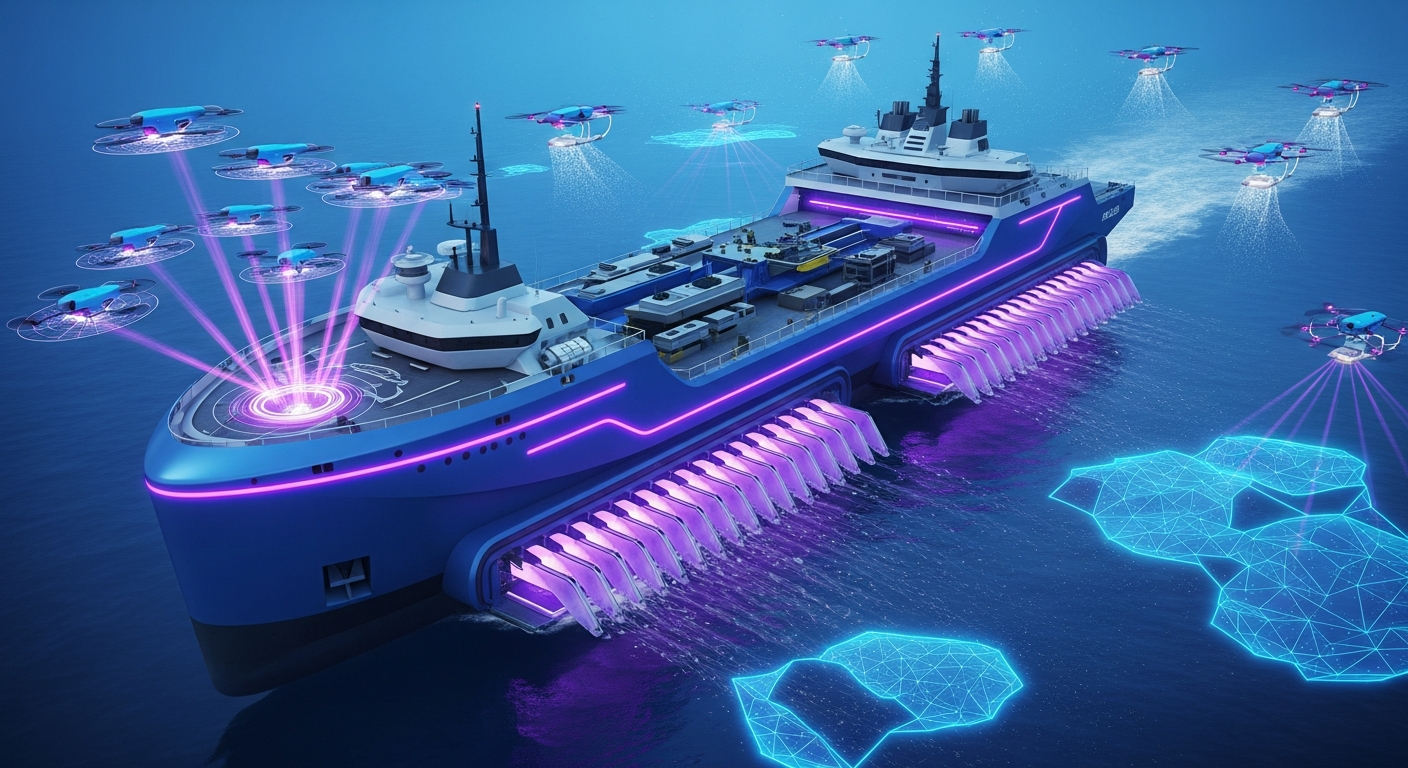
In 2026, the image of a single, massive vessel towing a net has been replaced by “Swarms.” These are fleets of small, autonomous underwater vehicles (AUVs) and unmanned surface vessels (USVs) that operate using decentralized intelligence—much like a school of fish or a hive of bees.
These robotic units are equipped with edge computing capabilities, allowing them to process environmental data in real-time without constant communication with a mother ship. This significantly reduces energy consumption and operational costs. The tech works through a multi-layered sensor suite: LiDAR for surface detection, sonar for submerged debris, and computer vision powered by neural networks to distinguish between organic matter (like jellyfish or kelp) and anthropogenic waste (like ghost nets or plastic bottles).
The innovation lies in the coordination. Using mesh networking, these bots communicate with one another to surround large debris fields, optimizing their formation to capture the maximum volume of plastic with minimal energy expenditure. Once a bot reaches its payload capacity, it autonomously returns to a solar-powered “hub” station to offload the waste before returning to its grid. This 24/7 autonomous cycle ensures that cleanup efforts are no longer limited by human endurance or fossil fuel logistics.
2. AI-Driven Predictive Modeling and Satellite Surveillance
One of the greatest challenges in ocean cleanup has historically been the “needle in a haystack” problem. The ocean is vast, and plastic moves according to complex thermohaline circulations and weather patterns. By 2026, we have solved this through a sophisticated integration of satellite-based hyperspectral imaging and AI-driven predictive modeling.
Current satellite constellations now utilize sensors that can detect the specific spectral signature of various polymers from orbit. This data is fed into “Digital Twin” models of the Earth’s oceans. These AI models simulate millions of variables—wind speed, current velocity, salinity levels, and even tidal shifts—to predict where “hotspots” of plastic will form 72 hours before they actually appear.
This shift from reactive to proactive cleanup is a game-changer. Instead of wandering the open sea, cleanup fleets are deployed to high-probability zones with surgical precision. For the tech-savvy reader, this is essentially “Just-in-Time” logistics applied to environmental remediation. Furthermore, this data is often hosted on decentralized ledgers (blockchain), ensuring that the data regarding ocean health is transparent, immutable, and accessible to researchers and NGOs globally.
3. Bioremediation: Engineering Microbes to Dissolve Plastic
While robotics tackle the visible “macro-plastics,” a far more insidious threat exists at the microscopic level. Microplastics and nanoplastics have infiltrated every level of the marine food web. To combat this, 2026 has seen the maturation of synthetic biology and bioremediation.
Researchers have successfully stabilized and deployed “Plastic-Eating” enzymes, derived from the bacterium *Ideonella sakaiensis*, into controlled marine environments. The 2026 approach involves nano-filtration “bio-reactors” attached to existing shipping vessels. As these ships move through the water, they intake seawater, where concentrated enzymes break down PET and PE plastics into their basic, non-toxic monomers (ethylene glycol and terephthalic acid) within hours.
A second, more experimental approach involves “Magnetic Bio-Carbon.” These are engineered particles that bind to microplastics and can be easily retrieved using magnetic arrays. This molecular-level cleaning ensures that we aren’t just removing the trash we can see, but also the chemical pollutants that threaten the very base of the oceanic food chain. The integration of “kill-switches” in these engineered microbes ensures they cannot survive outside of the specific cleanup zones, preventing unintended ecological consequences.
4. Advanced Materials: The Rise of Ferrofluids and Nano-Coils
The physics of 2026 ocean cleanup has also evolved. Traditional filtration often clogs or requires frequent replacement, making it unsustainable for long-term ocean deployment. Enter ferrofluids and functionalized nano-coils.
Ferrofluids—liquids that become strongly magnetized in the presence of a magnetic field—are being used to “trap” oil spills and microplastics simultaneously. When a non-toxic ferrofluid is released into a polluted area, it binds to hydrocarbons and plastic particles. Large magnetic booms then sweep the area, lifting the fluid and the contaminants out of the water with nearly 99% efficiency.
Complementing this are nano-coils: microscopic, spring-shaped carbon tubes coated in nitrogen and manganese. These coils react with the microplastics to create highly reactive oxygen species, which effectively dissolve the plastic without harming surrounding marine life. This is “active” chemistry at work, turning the ocean itself into a self-cleaning medium when catalyzed by the right materials. This technology is currently being integrated into wastewater treatment plants globally to stop plastic at the source before it ever reaches the open sea.
5. The Circular Economy 2.0: Waste-to-Value Integration
In 2026, the technology is not just about “taking trash out”; it is about what we do with it once it’s recovered. The economic viability of ocean cleanup has been bolstered by advanced molecular recycling.
Older recycling methods often “downcycled” plastic, resulting in lower-quality materials. The innovative 2026 approach uses “Chemical Upcycling.” Recovered ocean plastic is broken down into its constituent gases or liquids and then rebuilt into high-performance polymers. These materials are now used in the production of high-end electronics, carbon-fiber composites for the aerospace industry, and even 3D-printing filaments for sustainable housing.
To track this, IoT (Internet of Things) sensors are embedded in the collection bins. Every kilogram of plastic collected is tagged with a unique digital identifier. Companies can then purchase “Ocean Plastic Credits” with the certainty that the material in their supply chain was truly recovered from the sea. This creates a self-sustaining financial ecosystem where the value of the recovered material helps fund the expansion of the robotic swarms.
6. Real-World Applications in 2026: From Harbors to the High Seas
How does this look in practice? In 2026, the impact is visible in both localized and global scales:
* **Smart Harbors (Singapore & Rotterdam):** These ports now feature “Interceptors”—autonomous barges that sit at the mouths of rivers. These units use AI to identify and divert 100% of river-borne plastic before it enters the ocean. They are entirely powered by onboard solar and hydro-kinetic turbines.
* **The Great Pacific Initiative:** A coordinated effort involving three “Super-Swarms” (totaling 5,000 robotic units) is currently on track to reduce the mass of the North Pacific Gyre by 50% by the end of the decade.
* **Community-Scale Bio-Fencing:** In coastal regions of Southeast Asia, low-cost “Bio-Fences” use the aforementioned enzyme-infused filters to protect local coral reefs from microplastic sedimentation, preserving local tourism and fishing industries.
Impact on Daily Life: Why the Tech-Savvy Should Care
You might wonder how a robot in the middle of the Pacific affects someone living in a landlocked city. The impact of ocean cleanup technology in 2026 is profound and direct:
1. **Food Chain Integrity:** With the drastic reduction of microplastics, the toxicity levels in commercially available seafood have begun to stabilize. The “bioaccumulation” of toxins is being reversed, leading to healthier protein sources for billions of people.
2. **Climate Regulation:** The ocean is our largest carbon sink. By removing plastic that interferes with the vertical migration of phytoplankton (which sequester CO2), these technologies are indirectly cooling the planet.
3. **Economic Stability:** The “Blue Economy” is expected to contribute trillions to global GDP. Clean oceans mean more resilient coastal cities, more productive fisheries, and a booming market for “reclaimed” materials.
4. **The “Green” Tech Evolution:** The sensors and AI developed for ocean cleanup are already being “spun off” into other sectors, such as precision agriculture and urban waste management, making our overall infrastructure smarter and more efficient.
FAQ: Understanding Ocean Cleanup in 2026
Q1: Won’t these robots harm marine life while they collect plastic?
No. In 2026, all autonomous systems use “Bio-Acoustic Awareness.” They emit low-frequency signals that gently deter fish and marine mammals. Additionally, their computer vision systems are trained to recognize biological movement, causing the units to immediately power down or change course if a living organism enters their collection perimeter.
Q2: Is the energy used to power these systems creating more pollution?
The vast majority of 2026 cleanup technology is “Energy-Positive.” They utilize solar panels, wave-energy converters, and even the thermal gradient of the water to power themselves. The carbon footprint of recovering the plastic is significantly lower than the carbon cost of letting the plastic remain in the ocean.
Q3: How do we handle the “Ghost Nets” that are too heavy for small robots?
For heavy-duty debris like abandoned industrial fishing nets, “Heavy-Lift” USVs are deployed. These are larger vessels that act as the “muscle” for the swarm, called in only when the smaller bots flag a high-mass target that requires significant torque to move.
Q4: Is this technology only available to wealthy nations?
One of the core innovations of 2026 is “Open-Hardware” designs. Many of the drone blueprints and AI models are open-source, allowing developing nations to build their own fleets using local materials. This democratization of tech is essential for a global problem.
Q5: Can these enzymes survive in the cold, high-pressure depths of the ocean?
Current research focuses on “Extremophile-Derived” enzymes. These are engineered to function at the low temperatures of the deep sea (benthic zone), where a significant portion of plastic eventually sinks. While most work happens on the surface, deep-sea bioremediation is the next frontier.
Conclusion: A Forward-Looking Perspective
As we look toward the remainder of the decade, it is clear that the innovative approaches of 2026 are not just a “band-aid” on a wound; they represent the beginning of a proactive planetary management system. The era of passive conservation is over. We have entered the era of active restoration.
The technology we have discussed—from AI swarms to plastic-eating enzymes—demonstrates that the same human ingenuity that inadvertently created the plastic crisis is now our most potent tool for solving it. However, the tech is only as effective as the policy supporting it. As we move closer to 2030, the integration of these technologies into international maritime law will be the final piece of the puzzle. For the tech-savvy, the message is clear: the ocean is no longer a dumping ground; it is a high-tech laboratory where we are learning how to save our world, one bit and one molecule at a time. The tide is not just turning; we are turning the tide ourselves.