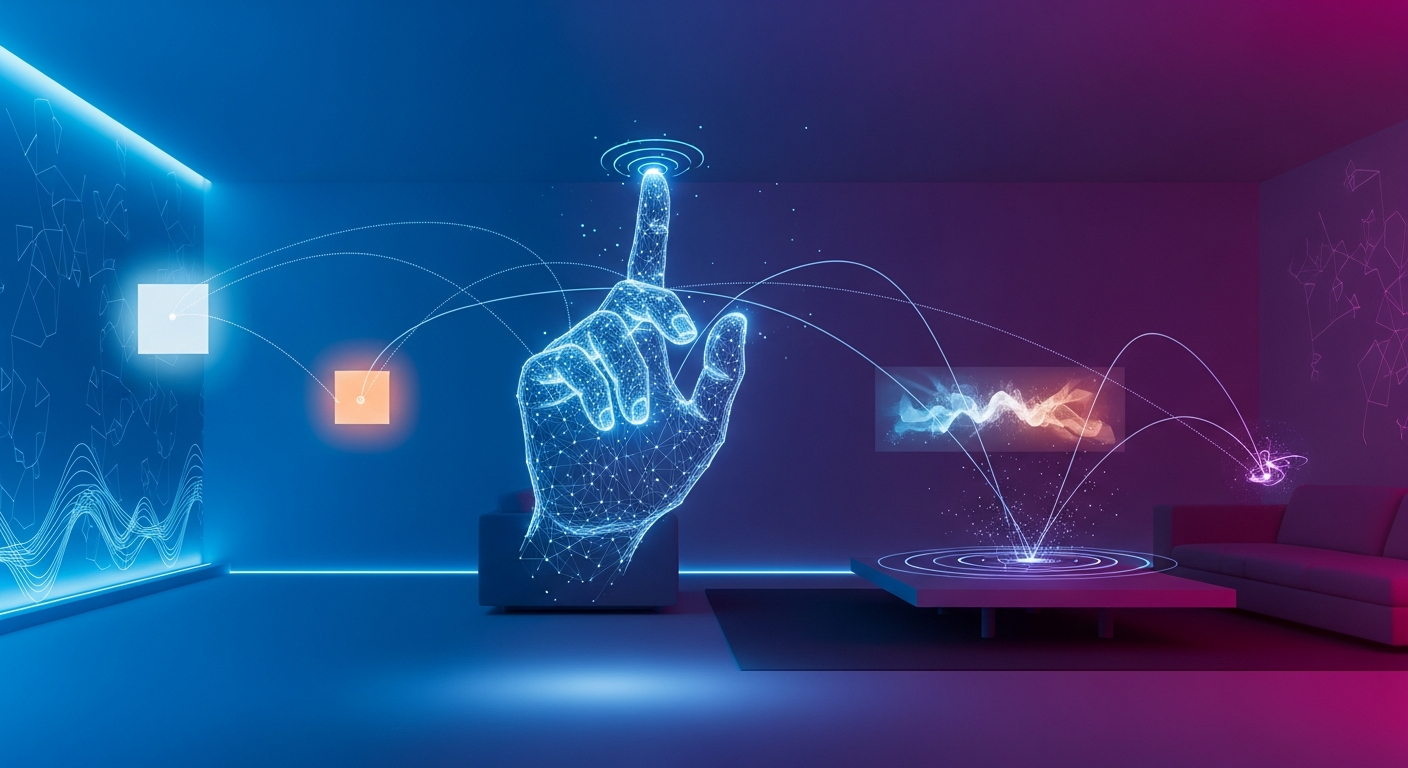
Beyond the Screen: How Gesture Control is Redefining the 2026 Smart Home
For decades, the way we interacted with our homes was defined by physical contact. We flipped switches, turned knobs, and eventually, tapped glass screens. Then came the era of voice activation, which promised a hands-free future but often left us shouting at inanimate objects in the dark or worrying about “always-listening” microphones. As we move through 2026, the paradigm has shifted once again, moving toward a more silent, intuitive, and sophisticated interface: gesture control technology.
Gesture control is no longer a gimmick found in high-end luxury cars or experimental gaming consoles. It has matured into a foundational element of the modern smart home. By leveraging advanced spatial computing, millimeter-wave radar, and computer vision, our living spaces have become responsive environments that anticipate our needs based on a simple wave of a hand or the flick of a wrist. This technology bridges the gap between the digital and physical worlds, offering a level of convenience and accessibility that was once the stuff of science fiction. In this comprehensive guide, we explore the mechanics, applications, and profound impact of gesture control as it stands at the forefront of 2026’s technological landscape.
What is Gesture Control Technology?
At its core, gesture control technology is a form of Human-Computer Interaction (HCI) that allows users to operate devices through bodily movements without physical contact. Unlike touchscreens that require tactile input or voice assistants that require acoustic input, gesture-based systems rely on spatial awareness. In the context of 2026 home automation, this doesn’t just mean waving broadly at a TV; it refers to a high-fidelity understanding of “micro-gestures”—fine motor movements of the fingers and hands that can be translated into complex commands.
There are two primary categories of gesture recognition: contact-based and non-contact-based. While contact-based systems (like wearable rings or smart gloves) exist, the 2026 smart home trend focuses almost exclusively on non-contact, “vision-based” or “sensor-based” systems. These systems create a virtual interaction zone around a device or throughout a room. When a user enters this zone, the system tracks their skeletal structure or skin surface in real-time.
The goal of modern gesture control is “frictionless interaction.” It aims to make controlling your environment as natural as pointing at an object you want or held-hand motions to signify “stop” or “increase.” By removing the need for a physical remote or a smartphone app, gesture control returns the “human” element to technology, allowing our natural movements to serve as the universal remote for our lives.
The Mechanics of Motion: How Gesture Recognition Works
The seamless experience of dimming your lights with a downward palm motion is supported by a complex stack of hardware and software. In 2026, the technology has moved beyond basic infrared sensors to a multi-modal approach.
1. Computer Vision and Deep Learning
High-definition cameras paired with Neural Processing Units (NPUs) are the backbone of many systems. These cameras don’t just “see” an image; they use deep learning algorithms to identify human anatomy. By identifying “landmarks” on the hand—such as knuckles and fingertips—the system can track movement in 3D space with sub-millimeter precision.
2. Millimeter-Wave (mmWave) Radar
Popularized by early pioneers like Google’s Project Soli, mmWave radar has become standard in 2026 home hubs. Unlike cameras, radar does not require light to function and, crucially, maintains user privacy because it doesn’t “see” identifiable faces or shapes. It emits electromagnetic waves that bounce off the hand, measuring the Doppler shift to detect velocity, distance, and angle. This is what allows for “invisible” controls, like rubbing your thumb and forefinger together to adjust volume.
3. Time-of-Flight (ToF) and LiDAR
ToF sensors and LiDAR (Light Detection and Ranging) emit light pulses and measure the time it takes for them to return. This creates a real-time depth map of the room. In 2026, these sensors are often embedded in smart mirrors and kitchen appliances to ensure that gestures are accurately captured even when the user is moving around the room.
4. Edge Computing
One of the biggest breakthroughs leading into 2026 has been the shift to edge computing. Rather than sending video or radar data to the cloud for processing—which introduces latency—gesture recognition now happens locally on the device. This ensures near-instantaneous response times, making the interaction feel “live” rather than delayed.
The 2026 Smart Home Ecosystem: Practical Applications
In 2026, gesture control is no longer a standalone feature; it is integrated into the fabric of the home. Here is how it manifests in different areas of daily life:
The Intuitive Kitchen
The kitchen is perhaps the most practical proving ground for gesture tech. When your hands are covered in flour or raw meat, touching a screen or a physical knob is unhygienic. In 2026, smart ovens and refrigerators respond to mid-air swipes. A “shooing” motion might dismiss a timer, while a circular motion in the air adjusts the temperature of an induction cooktop. Smart faucets now use proximity and gesture to toggle between a steady stream and a spray, or to dispense a precise measurement of water.
Immersive Living Rooms
The “remote control graveyard” is a thing of the past. Modern entertainment systems use spatial awareness to know who is sitting where. Pointing at the television selects a profile, while a “pinch and pull” motion zooms in on a detail during a sports broadcast. Furthermore, as Augmented Reality (AR) glasses become more common in 2026, gesture control serves as the primary way to interact with virtual screens floating in your living room, allowing you to “grab” and “toss” digital windows across the wall.
Hygiene and Health in the Bathroom
Smart mirrors have evolved into wellness hubs. Without touching the glass and leaving smudges, users can swipe through their morning schedule, check the weather, or follow a skin-care routine. Gesture sensors in showers allow users to adjust water pressure and temperature without fumbling with slippery handles, reducing the risk of falls and improving accessibility for the elderly or those with disabilities.
Security and Lighting
Entering a home in 2026 often involves a “gesture key.” A specific, private hand motion performed in front of a smart doorbell can unlock the door, serving as a form of behavioral biometrics. Inside, lighting systems use “follow-me” logic; a simple pointing gesture toward a dark corner can activate a localized spotlight, while a “closing” hand motion can shut the blinds and dim the room for a movie.
The Shift from Voice to Silence: Why Gestures are Winning
While voice assistants like Alexa and Siri paved the way for hands-free control, they hit a ceiling. Gesture control addresses the three primary pain points of voice technology: privacy, social friction, and environmental noise.
Privacy is the most significant factor. In a world increasingly wary of data collection, many users are uncomfortable with microphones that are always on. Gesture systems—particularly those using radar or local-only vision processing—offer a “privacy-first” alternative. They don’t record what you say, and in many cases, they don’t even record what you look like; they only see the geometry of your movement.
Social friction is another barrier. Talking to a machine can feel awkward when you have guests over, or it can wake up a sleeping baby. Gestures are silent. You can turn off a blaring alarm or dim the lights without making a sound. Furthermore, in 2026, gesture control solves the “noisy environment” problem. A voice assistant might struggle to hear you over a vacuum cleaner or a loud movie, but a visual or radar-based sensor remains unaffected by the acoustic landscape.
Finally, gestures offer “analog” precision that voice cannot match. Telling a light to “be a little bit dimmer” is subjective and often requires multiple attempts. Using your hand to physically “lower” the light level provides a 1:1 haptic-like feedback loop that feels much more controlled and satisfying.
Technical Hurdles and the Road to Standardization
Despite its ubiquity in 2026, gesture control technology has faced significant hurdles. The primary challenge was “The Midas Touch” problem—the tendency of the system to interpret accidental movements as commands. Early versions often saw someone waving at a friend and accidentally turning off the TV.
To solve this, 2026 systems utilize “Intent Detection.” By analyzing the speed, trajectory, and eye gaze of the user, AI can differentiate between a casual movement and a deliberate command. If you aren’t looking at the device, it is much less likely to respond to your gestures.
Standardization has also been a major focus. In the early 2020s, every manufacturer had their own “language” of gestures. In 2026, we have seen the emergence of a “Universal Gesture Language” (UGL), supported by industry giants. Much like the “pinch-to-zoom” became a universal standard for touchscreens, specific gestures—like the “L” shape for volume or the “Flat Palm” for stop—now work across brands, whether you are using a Samsung fridge or an Apple HomeHub.
Finally, power consumption was a hurdle for battery-operated devices. The development of ultra-low-power radar chips has been essential, allowing gesture-sensing to remain active on battery-powered doorbells and remotes for months without a recharge.
The Impact on Daily Life: A New Dimension of Interaction
The true impact of gesture control in 2026 is how it makes technology “disappear.” We are moving away from a world where we serve our devices—finding them, unlocking them, and navigating their menus—to a world where our devices serve us.
For the aging population and individuals with mobility issues, gesture control is a game-changer. It provides a sense of autonomy; someone who struggles with fine motor skills required for a small remote can use larger, gross motor arm movements to control their environment. For children, it makes the home a more interactive and educational space, where the environment responds to their curiosity.
Beyond utility, there is an aesthetic shift. Without the need for buttons, switches, and screens on every surface, home design in 2026 has become more minimalist. Walls are cleaner, and appliances look more like furniture than machines. The technology is ambient, hidden behind the drywall or tucked into the ceiling, waiting for a human presence to call it to life.
FAQ
Q1: Does gesture control work in the dark?
Yes. While early camera-based systems struggled in low light, 2026 home devices primarily use mmWave radar and infrared ToF sensors. These technologies do not require visible light and work perfectly in pitch-black conditions.
Q2: Can my pets trigger gesture-controlled devices?
Modern systems use skeletal tracking and AI filtering to distinguish between humans and animals. While a dog jumping on the sofa might have triggered a device in the past, 2026 AI is trained to recognize specific human hand geometries, making “pet-triggering” extremely rare.
Q3: Is my privacy at risk if there are sensors everywhere?
Most 2026 gesture sensors are designed for “Edge Processing.” This means the data never leaves the device and is never stored as an image. Radar-based systems are particularly private, as they only perceive a “cloud of points” rather than a high-resolution visual of the room.
Q4: Will gesture control replace voice assistants?
Not entirely. Gesture control is best for “spatial” and “binary” tasks (volume, lights, navigation), whereas voice is better for “complex data” tasks (searching for a specific movie title, adding items to a list). In 2026, the two work in tandem as “multimodal interfaces.”
Q5: Is it difficult to learn the gestures?
Not at all. The industry has converged on intuitive, “natural” gestures that mimic how we interact with the physical world. Most systems also include a “ghost UI”—a faint visual projection or light cue that guides your hand if you look like you’re struggling.
Conclusion: Toward an Ambient Future
As we look toward the remainder of the decade, gesture control is merely the first step toward “Ambient Intelligence.” The ultimate goal is a home that doesn’t even wait for a gesture, but instead uses predictive AI to adjust the environment before you even realize you need it. However, gesture control remains the vital link that keeps the human in the driver’s seat. It provides a level of intentionality and “magic” that keeps our interactions with technology feeling personal and empowered.
By 2026, the “touchless” home has moved from a luxury to a standard expectation. We have moved past the era of frustrating menus and misplaced remotes. We are finally living in an era where our homes understand the silent language of our bodies, making our living spaces more responsive, more accessible, and more human than ever before. The future isn’t just something we watch on a screen—it’s something we shape with our own hands, right in the air in front of us.