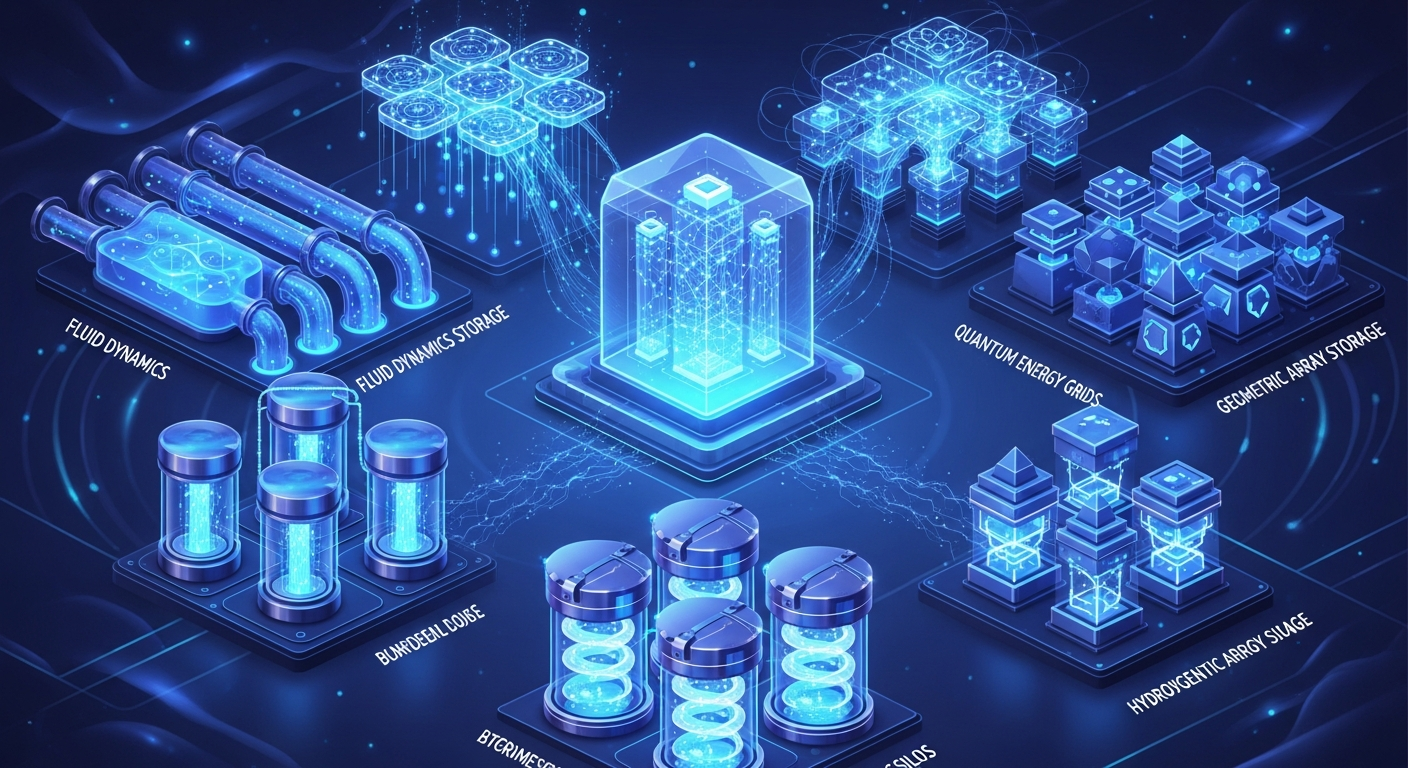
The Power Shift: Innovations in Renewable Energy Storage Solutions for 2026
The global transition toward a carbon-neutral future has hit a critical inflection point. While solar panels and wind turbines have become ubiquitous sights across our landscapes, the primary challenge has never been generation; it has been the “intermittency problem.” In simpler terms, the sun sets, and the wind stops, but our demand for high-speed data, climate control, and industrial manufacturing never pauses. For decades, the missing link in the green revolution was an efficient, scalable way to store vast amounts of power for when the elements don’t cooperate.
As we move through 2026, we are witnessing the dawn of a new era. The “battery bottleneck” that once hindered the total adoption of renewables has been shattered by a wave of disruptive innovations. These are not just incremental improvements to old tech; they represent a fundamental reimagining of how we capture, hold, and deploy electrons. From solid-state breakthroughs to massive gravitational reservoirs, renewable energy storage solutions innovations are now the backbone of the global economy. This article explores the cutting-edge technologies that have transformed the grid in 2026, the mechanics behind their success, and how they are fundamentally rewriting the script of our daily lives.
The Mechanics of Modern Energy Storage: Moving Beyond the Battery
To understand the current landscape of 2026, we must first look at the mechanics of energy conversion. At its core, energy storage is the process of taking surplus electricity—generated during peak sun or wind hours—and converting it into a form that can be “parked” for later use. Historically, this meant lithium-ion batteries, which move ions through a liquid electrolyte. However, the modern grid requires a more diverse “storage mix” to handle different timescales.
Today’s storage innovations are categorized by their discharge duration. Short-duration storage (seconds to minutes) handles grid frequency regulation, preventing flickers and surges. Medium-duration (4 to 12 hours) manages the “daily cycle,” shifting afternoon solar power to evening peak hours. Long-duration storage (days to weeks) provides the ultimate insurance policy against seasonal shifts or extended periods of calm weather.
In 2026, the mechanics have evolved beyond chemistry. We now see the widespread use of mechanical and thermal systems. For instance, advanced compressed air energy storage (CAES) uses surplus electricity to pump air into underground salt caverns. When power is needed, the air is released to spin turbines. Similarly, “liquid air” storage involves cooling air to cryogenic temperatures until it turns to liquid, storing it in insulated tanks, and then re-gasifying it to drive generators. These physical transitions allow for massive energy density without the degradation issues seen in traditional chemical batteries.
Next-Gen Solid-State and Metal-Air Batteries: The High-Density Revolution
While the grid utilizes large-scale mechanical storage, the portable and residential sectors have been revolutionized by solid-state technology. By 2026, solid-state batteries (SSBs) have finally transitioned from the laboratory to mass production. Unlike the lithium-ion batteries of the early 2020s, SSBs utilize a solid ceramic or polymer electrolyte. This eliminates the risk of “thermal runaway” (fire) and allows for the use of lithium-metal anodes, which significantly increase energy density.
This innovation means that the electric vehicles (EVs) and home storage units of 2026 are lighter, safer, and can charge in under ten minutes. But the innovation doesn’t stop there. Iron-air batteries have emerged as the “budget king” for grid-scale storage. These batteries work on the principle of “reversible rusting.” During discharge, the battery breathes in oxygen from the air and converts iron metal to rust. During charging, an electric current turns the rust back into iron, releasing oxygen.
The brilliance of iron-air technology lies in its cost. Iron is abundant and incredibly cheap compared to cobalt or nickel. In 2026, massive iron-air “energy farms” are being deployed alongside wind farms, providing multi-day storage at a fraction of the cost of lithium-based systems. This has effectively “leveled” the cost of renewable energy, making it cheaper than coal or natural gas even when the cost of storage is included.
Long-Duration Storage: Flow Batteries and Thermal Energy Reservoirs
One of the most significant breakthroughs of 2026 is the maturity of Redox Flow Batteries (RFBs). Unlike conventional batteries where the energy is stored in solid electrodes, flow batteries store energy in liquid electrolyte tanks. To increase capacity, you simply build a larger tank. This decoupling of power (the size of the stack) and energy (the size of the tanks) makes them the perfect solution for industrial complexes.
Vanadium remains the gold standard for flow batteries because it can exist in several different states of oxidation, allowing for nearly infinite charge-discharge cycles without degradation. In 2026, we are seeing 20-year-old flow batteries still operating at 98% efficiency, a feat impossible for any lithium-based chemistry.
Parallel to flow batteries is the rise of Thermal Energy Storage (TES). This involves storing energy as heat or cold in materials like molten salt, specialized sand, or even concrete blocks. In 2026, “Sand Batteries” have become a popular solution in colder climates. These systems use excess wind power to heat sand to over 600 degrees Celsius. The heat is stored for months and then used to provide district heating for entire neighborhoods or to generate steam for industrial processes. It is a low-tech material approach solved with high-tech AI management, proving that innovation often lies in simplicity.
The Hydrogen Link: Green Energy Carriers as Grid Stabilizers
In 2026, green hydrogen has moved from a “future prospect” to a functional pillar of renewable energy storage solutions. Green hydrogen is produced through electrolysis, using surplus renewable electricity to split water into hydrogen and oxygen. While the “round-trip efficiency” of hydrogen (converting power to gas and back to power) is lower than that of batteries, its energy density by mass is unparalleled.
Hydrogen serves as the ultimate long-term storage medium. In 2026, surplus summer solar energy is converted into hydrogen and stored in repurposed natural gas pipelines and depleted oil reservoirs. This hydrogen is then used during the winter months, not just for power generation, but as a clean fuel for heavy shipping, aviation, and steel manufacturing—sectors that are notoriously difficult to electrify.
Furthermore, “Power-to-X” innovations have allowed us to convert this hydrogen into other synthetic fuels or ammonia, making renewable energy a shippable global commodity. A country with high solar radiance can now “bottle” its sunlight as hydrogen and export it to a region with less sun, creating a globalized, renewable-based energy market that stabilizes prices worldwide.
Real-World Applications in 2026: From Smart Cities to Decentralized Microgrids
The practical application of these technologies is most visible in the “Smart City” infrastructures of 2026. Urban centers are no longer passive consumers of energy; they are dynamic ecosystems of storage and generation. Building-integrated photovoltaics (BIPV) coupled with localized flow batteries in basement levels allow skyscrapers to operate independently of the main grid during peak load times.
Vehicle-to-Grid (V2G) technology has also reached mass adoption. In 2026, your electric car is not just a mode of transport; it is a mobile power plant. When plugged in at home or work, the car’s solid-state battery communicates with the grid. If there is a sudden spike in demand, millions of parked EVs collectively discharge a small percentage of their power to stabilize the system, with owners receiving automated micropayments for the service.
In rural and developing areas, decentralized microgrids have replaced the need for expensive, centralized power lines. A village can now rely on a combination of solar panels and a long-duration iron-air battery to provide 24/7 electricity. These microgrids are “islanding” capable, meaning if the main national grid fails due to a cyber-attack or extreme weather, the local community remains powered, creating a level of societal resilience never before seen in human history.
The Human Impact: How Advanced Storage Rewrites Our Daily Lives
The impact of renewable energy storage solutions innovations on daily life in 2026 is profound. The most immediate change is the “democratization of energy.” The volatility of electricity prices, which characterized the early 2020s, has vanished. With storage buffering the supply, the “duck curve”—the extreme price fluctuations based on solar availability—has been flattened.
For the average consumer, this means energy is now a predictable, low-cost utility. Home automation systems, powered by AI, manage the flow of energy between the rooftop solar, the home battery, and the EV. The system automatically stores energy when it’s cheapest (or free from the sun) and uses it when the grid is stressed. Many homeowners have transitioned to “prosumers,” actually making a profit by selling stored energy back to the community.
Beyond economics, there is a tangible sense of security. The “blackouts” that used to follow major storms are increasingly rare. Because storage is distributed across the grid rather than concentrated in a few large power plants, the system is “self-healing.” If one node goes down, the localized storage in homes and businesses kicks in instantly. We have moved away from a fragile, top-down energy model to a robust, “mesh” network of power that is as reliable as the internet.
FAQ: Understanding Renewable Energy Storage
Q1: Why is storage considered more important than the actual energy generation?
A: Generation is only half the battle. Because the most efficient renewables (solar and wind) are intermittent, we cannot rely on them for “base-load” power without storage. Storage allows us to decouple the *timing* of generation from the *timing* of consumption, making renewables a viable replacement for fossil fuels.
Q2: Is lithium still the dominant material in 2026?
A: While lithium-metal is the gold standard for high-performance applications like EVs and smartphones due to its energy density, it is no longer the “only” player. For grid-scale and long-duration storage, cheaper and more abundant materials like iron, vanadium, and sodium have taken over to ensure sustainability and lower costs.
Q3: How long can these new storage systems actually hold power?
A: It depends on the technology. Solid-state batteries are great for daily cycles (hours). Flow batteries and compressed air systems can hold energy for days. Green hydrogen and thermal sand batteries can store energy for months, allowing for “seasonal shifting” where summer energy is used in the winter.
Q4: Are these new storage technologies environmentally friendly?
A: Generally, yes. Innovations in 2026 focus heavily on “circularity.” Iron-air and sodium-ion batteries use earth-abundant materials that are easier to mine and recycle. Furthermore, the move away from liquid electrolytes in solid-state batteries reduces the use of toxic chemicals and makes the recycling process significantly safer.
Q5: Will these innovations actually lower my electricity bill?
A: Yes. By 2026, the “Levelized Cost of Storage” (LCOS) has dropped significantly. By reducing the need for expensive “peaker” plants (gas plants that only run during high demand) and preventing energy waste through “curtailment” (throwing away excess solar/wind), the overall efficiency of the grid increases, leading to lower costs for the end-user.
Conclusion: The Horizon of an Uninterrupted Green Future
As we look toward the final years of this decade, it is clear that the innovations in renewable energy storage solutions have done more than just solve a technical problem; they have fundamentally shifted our relationship with the planet. We are no longer bound by the immediate whims of the weather or the finite supply of combustible fuels.
The storage revolution of 2026 has provided the world with a “buffer” that allows for a truly circular and sustainable economy. We are seeing the emergence of a global energy internet, where power is shared across borders and stored in everything from the walls of our houses to the salt caverns beneath our feet. While challenges in global supply chains and mineral sourcing remain, the trajectory is undeniable. We have moved past the era of energy scarcity and into an era of energy management. The grid of the future isn’t just a set of wires; it is a massive, intelligent battery that ensures the light of the sun and the power of the wind are always available, exactly when and where we need them.